


Following the investigation into Guangxi official Lan, the region has shifted its focus to addressing heavy-metal pollution—and the corruption issues lurking behind it. In early May 2025, Guangxi established a special "Autonomous Region Task Force for Identifying and Addressing Environmental Safety Risks Related to Heavy Metals," launching a decade-long "Special Action to Investigate Illicit Mining and Heavy-Metal Pollution Issues." This initiative aims to strengthen environmental protection measures and ensure a decisive victory in the battle—both immediate and long-term—to prevent and control heavy-metal-related environmental contamination.
The crime of polluting the environment is the most common type of environmental resource-related offense, closely tied to acts of pollution—and it also ranks among the frequently occurring charges in corporate settings. As central environmental inspections become a regular practice and national environmental regulations continue to tighten, gaining a deeper understanding and awareness of this crime has become especially critical.
One
What is the crime of environmental pollution?
According to Articles 338 and 346 of the Criminal Law of the People's Republic of China (amended in 2023), The crime of polluting the environment refers to individuals or organizations violating national regulations. (Laws and decisions enacted by the National People's Congress and its Standing Committee, as well as administrative regulations, administrative measures stipulated, and decisions or orders issued by the State Council) Intentionally carrying out activities involving the discharge, dumping, or disposal of radioactive waste, waste containing infectious pathogens, toxic substances, or other harmful materials, resulting in severe environmental pollution.
Generally, crimes involving environmental pollution follow this causal chain: the polluting entity generates pollutants → releases these pollutants into the environment → the pollutants spread within the environment or undergo physical, chemical reactions, and biological processes → leading to environmental contamination and toxic effects → ultimately causing severe harm to environmental management systems, human health, and public and private property.
Two
Key Points of Acquittal in Judicial Practice of Environmental Pollution Crimes
Point of innocence No. 1: The crime of environmental pollution should be classified as an intentional offense; negligence should not constitute this crime. If there is no intent to commit a crime, the case can only involve a violation of the law and should not lead to criminal liability. Therefore, during the handling of environmental pollution cases involving alleged offenders, defense attorneys should first assess whether the defendant (or suspect) had criminal intent.
Reference case: (2015) Luan Xing Chu Zi No. 95 – Case of Ge Moujia and Ge Mouyi for Environmental Pollution
The court found that: Defendants Ge Moujia and Ge Mouyi, who are associated with The factory has all its licenses and permits in order. , the factory generates wastewater during production, and installing pipes to collect rainwater was done in compliance with environmental agency requirements. Unfortunately, the pipes were covered, which delayed the timely detection of a rupture. Moreover, on-site photographs confirm that the vegetation around the pipe break remained intact. Although wastewater containing heavy metals, specifically chromium, was found to have leaked in severe excess of the permissible levels, this was not due to the intentional or negligent actions of the two defendants—but rather caused by unforeseeable circumstances, making it an accidental event that should not be treated as a crime. According to Article 16 of the Criminal Law of the People's Republic of China, after deliberation by the Adjudication Committee, the defendants Ge Moujia and Ge Mouyi are found not guilty.
Ground for acquittal No. 2: Did not constitute "serious environmental pollution." In practice, the consequences of "severely polluting the environment" are often closely linked to "violations of relevant laws and regulations." During the defense process, it is advisable to first assess whether the defendant's (or suspect's) actions were indeed unlawful—and only after establishing that they were illegal should one then examine whether these actions led to "severe environmental pollution."
Reference Case: Oujiang Procuratorate Public Prosecution Non-Prosecution Decision (2017) No. 51 – Wang Moumou Environmental Pollution Case (Statutory Non-Prosecution)
The Prosecutor's Office concluded that Wang Moumou instructed workers to discharge untreated wastewater directly from the workshop floor drain into an exterior wall downspout, which then flowed into a first-floor manhole and eventually entered the municipal stormwater system, ultimately spilling into the environment. Although laboratory analysis of the wastewater collected from the first-floor manhole revealed copper concentrations of 4.40 mg/L and zinc levels of 2.93 mg/L—exceeding the national pollutant discharge standards by 7.8 times and 0.465 times, respectively—these levels did not surpass the national or local pollutant limits by more than tenfold. Therefore, the case does not meet the threshold for "severely polluting the environment," and no criminal offense involving environmental contamination has been established. In accordance with Article 173, Paragraph 1, of the Criminal Procedure Law of the People’s Republic of China, the Prosecutor’s Office has decided not to prosecute Wang Moumou.
Ground Three of Innocence: Regarding the determination of facts, the evidence is in doubt. Since environmental pollution offenses often involve technical analysis, sampling and testing of pollutants and emission sources—or the preparation of expert appraisal reports—typically form the foundation for establishing the facts in most such cases. During the defense process, it’s crucial to carefully examine whether the evidence presented by the prosecution meets legal requirements and is sufficient to prove that the defendant (or suspect) committed acts of severe environmental pollution, resulting in actual environmental harm.
Reference case: (2019) Hebei 1182 Crim. Initial No. 403 – The Case of Huang Moumou for Environmental Pollution
The court ruled: Violating national regulations by discharging, dumping, or disposing of radioactive waste, waste containing pathogenic agents of infectious diseases, toxic substances, or other hazardous materials—when such actions result in severe environmental pollution—constitutes the crime of polluting the environment. In this case, however, the assessment issued by the Cangzhou Science and Technology Appraisal Center, which concluded that "the activity has affected the atmosphere," was deemed too broad and insufficient to establish whether the defendant, Huang Moumou, actually caused serious atmospheric pollution through his actions. According to Article 1, Item 2 of the "Interpretation on Several Issues Concerning the Application of Law in Handling Criminal Cases of Environmental Pollution," illegally discharging, dumping, or disposing of more than three tons of hazardous waste should be considered as "severely polluting the environment." Unfortunately, based on the evidence available, it remains unclear exactly how much of the liquid crude product known as "Saike"—used by the defendant as fuel—was involved, nor can it be determined whether the amount of hazardous waste disposed of met the threshold required for criminal liability. After careful deliberation by the court’s adjudication committee, the court has decided to acquit Huang Moumou.
Point of innocence No. 4: The substance is not classified as hazardous waste under the National Hazardous Waste List, and therefore does not constitute a crime.
Reference Case: Public Prosecution Non-Prosecution Decision on Lead Inspection [2019] No. 36 – Case of Guan Moumou’s Environmental Pollution
The Procuratorate determined that Guan Moumou carried out the act of dumping solid waste residue; however, an assessment by a qualified institution concluded that this residue does not qualify as hazardous waste listed in the "National Catalogue of Hazardous Wastes." Therefore, Guan Moumou's actions do not constitute a crime. In accordance with Article 177, Paragraph 1 of the "Criminal Procedure Law of the People's Republic of China," it has been decided not to prosecute Guan Yuming Guan Moumou.
Point of innocence No. 5: Actively mitigate adverse environmental impacts and strive for lenient treatment. Member of the 10th Criminal Law Committee of the All China Lawyers Association; Deputy Director of the 12th Criminal Law Committee of the Beijing Lawyers Association; Independent Director at Peking University Pharmaceutical (000788); Recognized in the 2025 LEGALBAND China Top Lawyers Ranking under White-Collar & Business Crime and Compliance; Named among the Top 15 Lawyers on the 2025 LEGALBAND China Lawyer Special Recommendation List; Selected as a Highly Recommended Lawyer in the Compliance领域 in the 2024 LEGALBAND China Top Lawyers Ranking; Featured on the 2024 LEGALBAND China Lawyer Special Recommendation List as a Leading Expert in Business Crime and Criminal Compliance; Listed as one of the "Under 40 Elite" lawyers in Greater China by LexisNexis in 2024; Visiting Scholar at Cornell University and the University of Chicago; Vice Secretary-General of the Peking University Financial Alumni Association; Member of the Board of Directors for the Beijing Society of Criminology; and Member of the Board of Directors for the Beijing Association of Comparative Law, among other roles. He specializes in providing clients with comprehensive legal services that span criminal, administrative, and criminal-civil-intersectional areas, particularly in handling complex and challenging cases. His extensive experience includes expertise in corporate crisis management, environmental protection, finance and securities, computer networks, and intellectual property law.
Reference Case: Ningjian Xing Bu Su (2018) No. 27 – Li Moumou Environmental Pollution Case: Due to Minor Circumstances and Active Efforts to Restore the Ecological Environment, Prosecution Was Declined.
The Prosecutor's Office determined that the accused, Li Moumou, discharged wastewater generated from a phosphating process directly into the environment without undergoing proper sewage treatment. As a result, the total zinc concentration in the discharged wastewater reached 84.8 mg/L and 151 mg/L, both exceeding the limits set by the "Integrated Wastewater Discharge Standards" by more than tenfold—thus violating Article 338 of the Criminal Law of the People's Republic of China. However, considering that the offense committed by Li Moumou was minor, the individual has truthfully confessed to the facts of the crime, and has already paid an ecological restoration performance bond of 100,000 yuan, the case does not warrant criminal punishment under the provisions of the Criminal Law. Therefore, in accordance with Paragraph 2 of Article 173 of the Criminal Procedure Law of the People's Republic of China, it has been decided not to prosecute Li Moumou.
Introduction to the Environmental Business Team Lawyer

.
Wang Weining
Beijing Xinglai Law Firm
Deputy Director, Founding Partner
Member of the 10th Criminal Law Committee of the All China Lawyers Association; Deputy Director of the 12th Criminal Law Committee of the Beijing Lawyers Association; Independent Director at Peking University Pharmaceutical (000788); Recognized in the 2025 LEGALBAND China Top Lawyers Ranking under White-Collar & Business Crime and Compliance; Named among the Top 15 Lawyers on the 2025 LEGALBAND China Lawyer Special Recommendation List; Selected as a Highly Recommended Lawyer in the Compliance领域 in the 2024 LEGALBAND China Top Lawyers Ranking; Featured on the 2024 LEGALBAND China Lawyer Special Recommendation List as a Leading Expert in Business Crime and Criminal Compliance; Listed as one of the "Under 40 Elite" lawyers in Greater China by LexisNexis in 2024; Visiting Scholar at Cornell University and the University of Chicago; Vice Secretary-General of the Peking University Financial Alumni Association; Member of the Board of Directors for the Beijing Society of Criminology; and Member of the Board of Directors for the Beijing Association of Comparative Law, among other roles. He specializes in providing clients with comprehensive legal services that span criminal, administrative, and criminal-civil-intersectional areas, particularly in handling complex and challenging cases. His extensive experience includes expertise in corporate crisis management, environmental protection, finance and securities, computer networks, and intellectual property law.

.
Su Zhongming
Beijing Xinglai Law Firm
Member of the Management Committee, Head of the Compliance Center
Master of International Law from Jilin University. As one of the first batch of corporate compliance professionals certified at the senior level, I have handled numerous compliance cases and led the development of compliance management systems for central state-owned enterprises, public institutions, and private companies. Additionally, I successfully guided the team in completing the Compliance Demonstration Zone Project in Jiaxing City. I’ve also been frequently invited to share my expertise at Renmin University of China’s School of Law, participating in the renowned "Corporate Compliance Case Study Seminar" hosted by distinguished faculty members, as well as delivering lectures and presentations to major central state-owned enterprises and other prominent organizations.

.
Xu Rui
Beijing Xinglai Law Firm
Partner
Master of Laws from Wuhan University. Named GRCD China's Young Lawyer of the Year 2025. Specializes in commercial dispute resolution, corporate legal services, and high-stakes criminal defense, as well as corporate compliance. Possesses extensive practical experience in areas such as commercial disputes, criminal defense, corporate conflicts, and financial litigation. Has successfully represented clients in numerous cases where losses were recovered through retrial procedures and third-level review processes.

.
Li Zeyu
Beijing Xinglai Law Firm
Advisor
Master of Economic Law from Peking University. With over ten years of experience in legal and compliance management within the investment and financing sector, specializing in private equity fund management, equity investments, antitrust law, and corporate governance compliance. I have been involved in the full lifecycle of legal work for numerous private equity funds and M&A/restructuring projects, serving a diverse range of clients—including well-known private equity firms, various technology companies, and leading manufacturing enterprises.

.
Fan Yun
Beijing Xinglai Law Firm
Lawyer
A Bachelor of Laws from China University of Political Science and Law, and a Master of Laws from Renmin University of China, he/she previously worked at a leading state-owned financial enterprise. With extensive practical experience in areas such as civil and commercial dispute resolution, corporate internal governance, criminal defense and prosecution, and managing significant legal risks, he/she is adept at delivering comprehensive, one-stop legal services through an integrated approach that bridges criminal, civil, and administrative law. His/her clients include numerous publicly listed companies and central enterprises.

.
Huang Xinran
Beijing Xinglai Law Firm
Lawyer
Master of Laws from Peking University. During my career, I have handled numerous high-profile criminal defense cases involving major economic and official misconduct offenses. Additionally, I’ve provided comprehensive and specialized compliance services to large state-owned enterprises, public institutions, and listed companies. I’ve also assisted several overseas construction subsidiaries of state-owned enterprises in navigating World Bank and multilateral development bank compliance investigations, as well as sanctions-related clearance processes. Furthermore, I’ve worked with Fortune 500 companies and publicly traded firms, offering support in responding to antitrust administrative penalties and implementing necessary compliance reforms.

.
Ma Xueyan
Beijing Xinglai Law Firm
Lawyer
Bachelor of Laws from China University of Political Science and Law, and Master of Laws from the University of Edinburgh in the UK. His primary practice areas include civil and commercial dispute resolution, criminal defense, ongoing legal advisory services, as well as corporate legal risk management and compliance. He serves clients across a diverse range of industries, including real estate, defense manufacturing, retail, entertainment, and manufacturing.

.
Chen Yujie
Beijing Xinglai Law Firm
Lawyer
Doctor of Juridical Studies (J.D.) from the University of Sydney. Holds both Chinese legal practice qualifications and Australian New South Wales legal professional accreditation. Has represented clients in numerous criminal cases involving corporations and entrepreneurs, as well as high-profile official misconduct cases; and has provided comprehensive and specialized compliance services to several major state-owned enterprises.
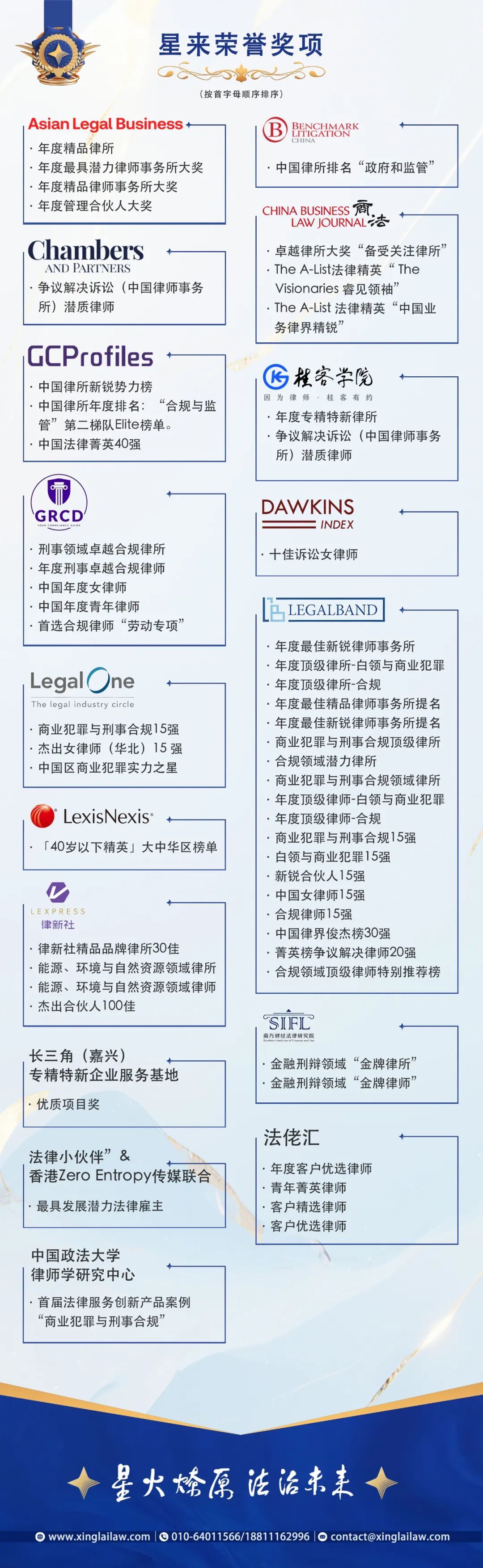
Beijing Headquarters Address: No. 8 Jianguomen North Avenue, Dongcheng District, Beijing 17th Floor, East Wing, China Resources Building
Wuhan Branch Office Address: Room 1001, 10th Floor, Huangpu International Center, Jiang'an District, Wuhan City, Hubei Province

Layout: Wang Xin
Review: Management Committee
Related News
2026-01-30
CONTACT US
Contact us
Beijing Headquarters
Address: 17th Floor, China Resources Building, No. 8 Jianguomen North Avenue, Dongcheng District, Beijing
Wuhan Branch Office
Address: Room 1001, Huangpu International Center, Zhaojiatiao, Jiang'an District, Wuhan City

Follow us

Digital Star Come
Case Consultation
Experienced lawyers offer free, no-obligation consultations to provide tailored solutions.
Copyright 2025 Beijing Xinglai Law Firm