

1. An "Audit Report" that reflects only the company's liabilities and profitability, but fails to disclose the flow of assets between the company and its shareholders, is insufficient to demonstrate that the company's assets are legally separate from those of its shareholders.
The Supreme People's Court held that Shengzun Company is a single-shareholder limited liability company established by Lizhao Company. During the second-instance proceedings, Lizhao Company submitted to this court the 2016–2018 Audit Reports of Lizhao Company and the 2016–2019 Audit Reports of Shengzun Company, intending to demonstrate that the assets of Lizhao Company and Shengzun Company are independently maintained, and therefore Lizhao Company should not be held jointly liable for Shengzun Company's debts.
This court holds that, The aforementioned audit report and other evidence only reflect the company's liabilities and profitability; they do not provide any insight into how the assets of Lizhao Company have been managed in relation to those of Shengzun Company. Therefore, this evidence is insufficient to prove that Lizhao Company’s assets are separate from Shengzun Company’s. According to Article 63 of the Company Law of the People’s Republic of China, which states that "if a shareholder of a one-person limited liability company cannot prove that the company’s assets are independent of their own, they shall bear joint and several liability for the company’s debts," Lizhao Company is legally obligated to assume joint and several liability for Shengzun Company’s debts.
2. The audit report failed to include the company's execution debts—information that could be readily accessed through public inquiries—on the company's balance sheet, clearly indicating an audit failure that renders the report inadmissible under the law.
The Supreme People's Court held that although Pang Hua submitted evidence, including the audit report of Huayang Company issued by an accounting firm, which purported to demonstrate the company's financial independence, the court found during its second-instance review that these audit reports failed to include the execution debts involved in the case—debts that could have been readily identified through public inquiries—in Huayang Company's balance sheet. This clearly indicates a failure in the auditing process, rendering the reports legally inadmissible.
After Huayang Company became a single-member limited liability company, it violated the provisions of Article 62 of the Company Law by failing to prepare financial accounting reports at the end of each fiscal year and have them audited by an accounting firm. The occurrence of this audit failure clearly indicates that the company’s financial management is in disarray. As the company’s sole shareholder, Pang Hua should bear the adverse consequences resulting from the commingling of corporate and personal assets.
Additionally, Civil Judgment No. 13 of the First Instance Final Appeal (2015) issued by this court also noted that Huayang Company and Jiudingta Company, both controlled by Pang Hua, exhibited commingling of assets. As a result, the court allowed enforcement actions against Jiudingta Company’s assets to satisfy Huayang Company’s outstanding debts involved in the case. These facts clearly demonstrate Pang Hua’s abuse of the company’s separate legal identity to evade debt obligations. Under Article 63 of the Company Law, Pang Hua should therefore bear joint and several liability for Huayang Company’s debts.
Case Index: Case No.: (2020) Supreme People's Court Min Zhong No. 1240; Judgment Date: December 31, 2020.
3. While the capital contributions and other objective details of the company at the time of business registration or amendment can be verified, verification and audit reports that reflect the company’s financial performance and cash flow—key aspects of its overall financial health—cannot, by themselves, prove that the company’s assets are legally separate from those of its shareholders.
The Supreme People's Court held that Jidong Company is the sole shareholder of Rufeng Company. If Jidong Company fails to prove that Rufeng Company’s assets are entirely separate from its own, it will be jointly and severally liable for Rufeng Company’s debts. During the first-instance trial, both Jidong Company and Rufeng Company submitted capital verification reports and audit reports, which, while demonstrating objective facts such as the company’s initial or amended capital contributions during business registration, were insufficient to establish that Rufeng Company’s assets remain independent from those of Jidong Company.
During the second-instance proceedings of this case, Jidong Company submitted RuiFeng Company's annual audit report, financial statements, organizational structure details, and operating contracts. Notably, the audit report was prepared solely at the request of RuiFeng Company. According to the audit report, RuiFeng's financial statements were prepared in accordance with corporate accounting standards and fairly present the company's operational results and cash flows for 2015 and 2017—providing a comprehensive overview of the company's financial position during those years. However, the report does not serve as evidence that Jidong Company's assets are legally separate from those of RuiFeng Company.
The company's financial statements, organizational structure, and business contracts demonstrate that the company has legal personality and independently engages in business activities externally, but they fail to prove that its assets are entirely separate from those of its shareholders. Therefore, this court does not accept the aforementioned evidence. The primary court’s decision holding Jidong Company jointly liable for Ruifeng Company’s debts was appropriate.
4. The audit report, which certifies that the company’s financial statements have been prepared in accordance with applicable standards and accurately reflect the company’s true financial position, along with the accompanying financial statements, does not provide evidence of whether the company’s assets are legally and financially separate from those of its shareholders.
The Supreme People's Court held that Article 63 of the Company Law of the People's Republic of China establishes a reversed burden-of-proof rule regarding the separation of assets in a one-person limited liability company: Specifically, the shareholder of such a company must provide evidence to demonstrate that the company’s assets are clearly separate from the shareholder’s personal assets. If the shareholder fails to meet this evidentiary burden, they shall be jointly and severally liable for the company’s debts. This provision represents a special legal arrangement tailored specifically for one-person limited liability companies and should take precedence over other applicable rules.
In this case, based on the evidence presented, although the energy company submitted the audit reports for the Property Company covering 2013 and 2014, along with selected accompanying financial statements, the audit opinions concluded only that the financial statements were prepared in accordance with applicable standards and accurately reflected the company's true financial position. However, these documents fail to establish whether the assets of the Energy Company and the Property Company are truly separate, thus falling short of achieving the energy company's intended purpose of proof.
Moreover, according to the balance sheet attached to the audit report, immediately after Zhuye Company was established on October 15, 2013, it had already invested 29 million yuan in Zhangjiakou Huafu Caitong Company—contradicting the statement made by the Energy Company during the second-instance court hearing at this court, which claimed that Zhuye Company was solely focused on developing the Guocang Building in question and conducted no other business or external activities.
According to Article 3 of the Equity Transfer Agreement between the Energy Company and Ruituo Company, neither the Energy Company nor Ruituo Company maintains independent financial records from the Property Company. Moreover, during the equity transfer, both parties proceeded to dispose of the Property Company's assets.
Therefore, since the energy company failed to provide sufficient evidence, it should bear joint and several liability for the property company's debts.
Case Index: Case No.: (2019) Supreme People's Court Min Zhong No. 1093; Judgment Date: December 31, 2019.
5. An audit report that does not fully reflect the company's actual business and financial conditions cannot prove that the company's assets are separate from those of its shareholders.
The Supreme People's Court held that Shangdao Company is a one-person limited liability company whose shareholder is Chen Xianghua. According to Article 63 of the Company Law of the People's Republic of China, "If a shareholder of a one-person limited liability company cannot prove that the company's assets are separate from the shareholder's own personal assets, the shareholder shall bear joint and several liability for the company's debts." Therefore, Chen Xianghua must provide evidence demonstrating that his personal assets are entirely independent of Shangdao Company's finances; otherwise, he will be jointly and severally liable for the debts owed by Shangdao Company in this case.
During the second trial of this case, Chen Xianghua and Shangdao Company jointly submitted evidence, including Shangdao Company's business license as a corporate entity and the company's capital verification report, to demonstrate that when Shangdao Company was established, Chen Xianghua had already fully invested the company's registered capital. Additionally, in 2006, he further invested 3 million yuan to open the Shangdao Coffee branch on Bailongnan Road. As a result, Shangdao Company's assets are entirely separate from Chen Xianghua's personal property.
The aforementioned evidence pertains solely to Chen Xianghua's investment in the registered capital of Shangdao Company and does not serve as proof of whether Shangdao Company's operations are financially independent from Chen Xianghua's personal assets. Therefore, the original court's ruling—that this evidence is insufficient to demonstrate the company's financial independence from Chen Xianghua's own assets—is correct.
In the retrial of this case, the original court reviewed documents submitted by Shangdao Company, including the company's audit reports from 2002 to 2009, as well as tax transfer vouchers from September 2006 to February 2007 for Shangdao Coffee's Bailongnan branch—evidence intended to demonstrate that Shangdao Company's assets are separate and distinct from Chen Xianghua's personal property.
Regarding the evidentiary value of the audit reports from 2002 to 2009, first, after the first-instance judgment was delivered in this case, Shangdao Company, dissatisfied with the ruling, filed an appeal. During the appeal process, Shangdao stated that it had invested 3 million yuan in the property in question—but this investment by Shangdao Company was not reflected in the aforementioned audit reports.
Second, according to the facts established during the original review, on October 11, 2005, after Shangdao Company signed the Lease Agreement with Fangyuan Company and Weicheng Property Management Company, it immediately paid a rental deposit of 50,000 yuan to Weicheng Property Management. Subsequently, Shangdao Company used the premises under the Lease Agreement to operate the Shangdao Coffee Bailongnan Branch, paying rent and property management fees through the end of January 2007. However, the business ceased operations by May 2009. Notably, these two investments and operational details were also not reflected in the aforementioned audit report.
Regarding the reasons why the operating conditions of the Shangdao Coffee Bailongnan branch were not reflected in the aforementioned audit report, First, In the original trial, Shangdao Company stated, "Shangdao Company is the party that signed the contract with Fangyuan Company. However, the Bailongnan branch of Shangdao Coffee was contracted out to employee Fu Chun for operation, with Fu Chun responsible for renovation investments and day-to-day management—activities entirely independent of Shangdao Company. Therefore, it is entirely appropriate that the financials of the Bailongnan branch are not reflected in Shangdao Company's financial statements." Based on this statement, an internal operational contracting relationship should exist between Shangdao Company and Fu Chun. Under such circumstances, Shangdao Company’s collection of a contract fee from Fu Chun aligns both with its nature as a commercial entity and with sound business logic. Consequently, Shangdao Company’s claim—that after contracting the Bailongnan branch to Fu Chun, the store’s operations have no connection to the company and thus shouldn’t appear in Shangdao’s financial reports—is simply not reasonable or consistent with common sense.
Second, During the original trial, Fu Chun stated that the Bailongnan branch of Shangdao Coffee was a franchise store operated jointly with his partner, Lin Yan. He explained that, as long-time employees of Shangdao Company, they were granted an exemption from the mandatory franchise fee by their employer, Jiang Yuchang. According to Fu Chun's account, this arrangement established a franchising contract relationship between Shangdao Company and himself. Under these circumstances, as the franchisee, Fu Chun was entitled to use the property in question to operate the Shangdao Coffee Bailongnan branch—and was therefore obligated to pay Shangdao Company the corresponding franchise fee, or "franchise fee," as stipulated in their agreement. Although Fu Chun claimed that, due to his longstanding employment with Shangdao Company, the boss waived the fee entirely, it is precisely because of this unique, pre-existing relationship between him and the company that his explanation fails to carry sufficient weight or credibility.
Third, During the retrial hearing at this court, although Chen Xianghua stated that there was no relationship whatsoever between Shangdao Company and the Shangdao Coffee Bailongnan branch operated by Fu Chun, and that the two parties were not in a franchise arrangement, the court found Chen Xianghua's statement to be clearly contradictory to the accounts provided by both Shangdao Company and Fu Chun during the original trial. Therefore, the court does not accept Chen Xianghua's assertion. Based on this, regardless of the exact legal relationship between Shangdao Company and Fu Chun—whether it’s the internally contracted management model previously claimed by Shangdao Company, or the franchise relationship described by Fu Chun—it remains consistent with sound business practices for Fu Chun to ultimately remit the relevant fees to Shangdao Company. Consequently, the arguments made by Chen Xianghua and Shangdao Company—that the Shangdao Coffee Bailongnan branch is entirely operated by Fu Chun, has no connection to Shangdao Company, and that the store’s investment and operational details should not be reflected in Shangdao Company’s financial records—or, by extension, that the store’s performance should not appear in the audit report—cannot stand.
Fourth, In the aforementioned audit reports, the reports for 2009, 2010, and 2011 all included qualified opinions. The primary qualifications were as follows: First, the auditing firm was unable to obtain bank reconciliation statements for Shangdao Company’s cash balances at the end of 2008, 2009, and 2010, nor did they conduct a physical count of cash on hand or implement alternative procedures to gather sufficient and appropriate audit evidence. Second, due to limitations in audit conditions, the firm did not perform a physical inventory count of ending inventory balances. Third, similarly constrained by audit conditions, they were unable to carry out an inventory count of fixed assets. Finally, because of these same audit constraints, the firm could not verify the accuracy of the company’s main business revenue, costs, and operating expenses.
Therefore, while the aforementioned audit report states that Shangdao Company's financial statements have been prepared in accordance with Enterprise Accounting Standards and the "Enterprise Accounting System" and fairly present the company's operating results for the year in all material respects, the facts of this case reveal that after leasing the property in question, Shangdao Company invested 3 million yuan into it and subsequently operated the Shangdao Coffee Bailongnan branch using the premises. However, neither this investment nor the operational status was reflected in the audit report, which also explicitly notes that the auditors have issued a qualified opinion on certain aspects of their review.
Therefore, the aforementioned audit report does not fully reflect Shangdao Company’s actual business operations and financial condition. Based on this, Kaicheng Company argues that the audit report fails to provide a complete and accurate representation of Shangdao Company’s financial status, nor does it demonstrate that the company’s assets are legally separate from those of its shareholder, Chen Xianghua—thus lending factual support to their position. The original court’s decision, which concluded that the renovation, operation, and investment details of Shangdao Coffee’s Bailongnan branch were not reflected in the audit report, was found to align with reality. However, by relying solely on this same audit report to determine that Shangdao Company’s assets remain independent of Chen Xianghua’s personal wealth—and consequently ruling that Chen Xianghua should not bear joint liability for the company’s debts in this case—the court’s findings lacked sufficient evidentiary backing and misapplied the relevant legal principles. As a result, this court has decided to correct the original judgment.
Case Index: Case No.: (2016) Supreme People's Court Min Re 318; Judgment Date: June 25, 2019.
6. Audit reports prepared separately by the company and its shareholders, which align with each other, ensure mutual financial independence.
The Supreme People's Court held that, considering the constitutive elements for denying the corporate personality of a single-member limited liability company, Xinli Company qualifies as such, with Beibu Gulf Port Co., Ltd. serving as its sole shareholder. During the first-instance trial, Beibu Gulf Port Co., Ltd. submitted a "Special Audit Report" demonstrating that its assets are entirely separate from those of Xinli Company, with no evidence of commingling. Moreover, this evidence aligns seamlessly with other documents on record, including Xinli Company’s annual audit reports. Thus, Beibu Gulf Port Co., Ltd. has fulfilled its burden of proof. Given that the existing evidence in this case is sufficient to establish the relevant facts, there is no need for an expert appraisal. Consequently, this court rejects Wengfu International’s request for an appraisal.
Case Index: Case No.: (2017) Supreme People's Court Min Zhong No. 569; Judgment Date: July 13, 2018.
Source: Supreme Court Interpretation
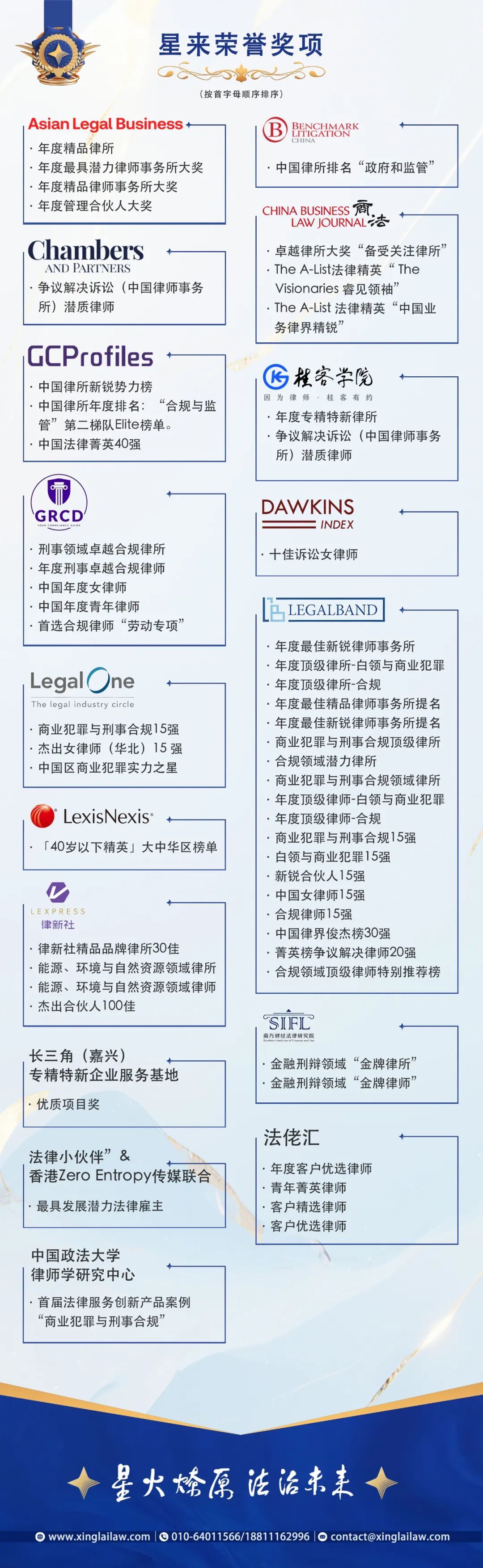
Beijing Headquarters Address: No. 8 Jianguomen North Avenue, Dongcheng District, Beijing 17th Floor, East Wing, China Resources Building
Wuhan Branch Office Address: Room 1001, 10th Floor, Huangpu International Center, Jiang'an District, Wuhan City, Hubei Province

Layout: Wang Xin
Review: Management Committee
Related News
2026-01-30
CONTACT US
Contact us
Beijing Headquarters
Address: 17th Floor, China Resources Building, No. 8 Jianguomen North Avenue, Dongcheng District, Beijing
Wuhan Branch Office
Address: Room 1001, Huangpu International Center, Zhaojiatiao, Jiang'an District, Wuhan City

Follow us

Digital Star Come
Case Consultation
Experienced lawyers offer free, no-obligation consultations to provide tailored solutions.
Copyright 2025 Beijing Xinglai Law Firm