

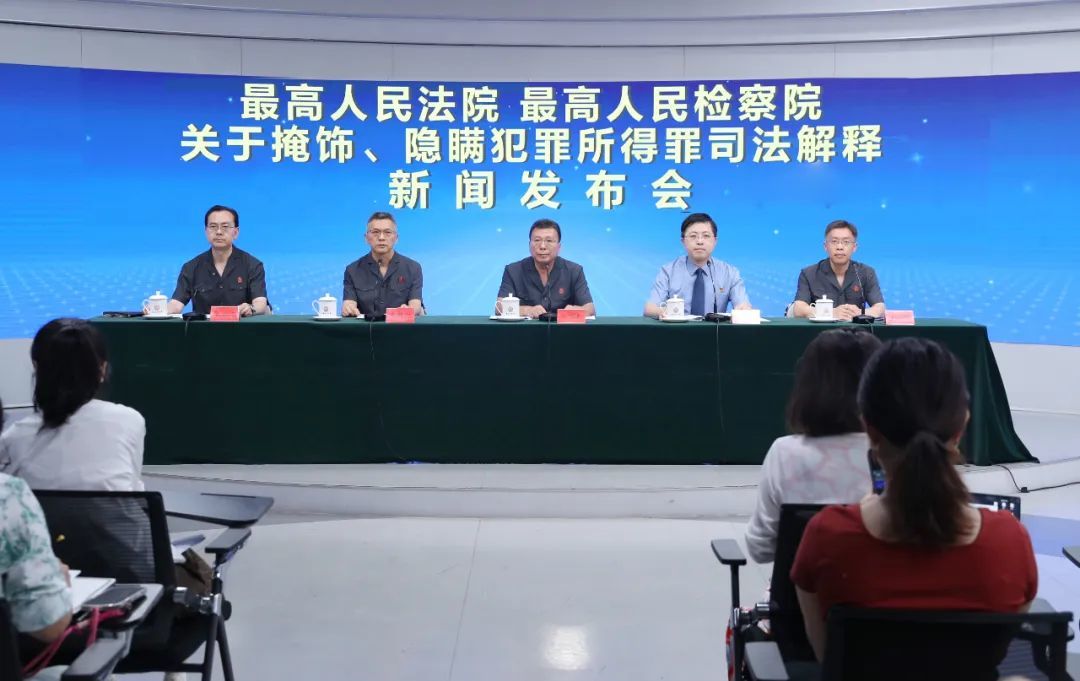
On August 25, 2025, the Supreme People's Court held a press conference to release the "Interpretation by the Two Supreme Courts on Several Issues Concerning the Application of Law in Handling Criminal Cases Involving Concealment or Disguise of Proceeds from Crime and Proceeds Derived from Such Crimes," along with typical cases where offenders were punished according to law for concealing or disguising criminal proceeds and profits. and answer questions from reporters Luo Guoliang, Chief of the Fourth Criminal Division of the Supreme People's Court; Si Mingdeng, Deputy Chief of the Fourth Criminal Division of the Supreme People's Court; Wu Qiaobin, Deputy Director of the Legal and Policy Research Office of the Supreme People's Procuratorate; and Wang Lei, a Second-Level Senior Judge from the Fourth Criminal Division of the Supreme People's Court, attended the press conference. The press conference was chaired by Ji Zhongbiao, Deputy Director of the Publicity Bureau of the Supreme People's Court. At the press conference, Luo Guoliang, Chief Justice of the Fourth Criminal Division of the Supreme People's Court, released the "Interpretation on Several Issues Concerning the Application of Law in Handling Criminal Cases Involving Concealment or Disguising of Proceeds from Crime and Benefits Derived Therefrom."
I. The Background Behind the Development of the Interpretation
Since the 18th National Congress of the Communist Party of China, the Party Central Committee—with Comrade Xi Jinping at its core—has placed great emphasis on anti-money-laundering efforts as well as combating and addressing crimes such as telecom and internet fraud and online gambling. The crime of concealing or hiding criminal proceeds and gains (hereinafter referred to as "concealment and hiding of criminal proceeds") is not only the most frequently prosecuted money-laundering offense in practice but also a downstream crime closely linked to upstream offenses like telecom and internet fraud and online gambling. Across the country, people's courts and procuratorates at all levels have thoroughly implemented the work arrangements set forth by the Party Central Committee, fully leveraging their judicial and prosecutorial functions to step up crackdowns on the crime of concealing or hiding criminal proceeds. From 2020 to 2024, procuratorial organs prosecuted 230,200 cases involving this crime, while people's courts concluded 220,900 first-instance cases. These robust measures have effectively deterred and curbed upstream crimes such as telecom and internet fraud and online gambling, significantly bolstered anti-money-laundering efforts, and underscored the judiciary's unwavering commitment to punishing crime, safeguarding the public, and supporting high-quality economic and social development.
In 2015, the Supreme People’s Court issued the "Interpretation on Several Issues Concerning the Application of Law in Handling Criminal Cases Involving Concealment and Disguise of Proceeds from Crime and Benefits Derived Therefrom" (Fa Shi [2015] No. 11), which has played a crucial guiding role in judicial practice. However, with the evolution of the economy and society and the changing landscape of crime, the legal application of offenses involving concealment and disguise of criminal proceeds now faces numerous new challenges and issues. For instance, criminal methods continue to evolve, becoming increasingly sophisticated and concealed, while also exhibiting trends toward organized group activities, interconnected criminal networks, and even industrial-scale operations. Meanwhile, the structural composition of upstream crimes has undergone significant shifts—moving away from primarily theft-based offenses toward a dominant reliance on fraud, especially telecom and cyber fraud. Additionally, debates persist over how to distinguish between the crime of concealing or disguising criminal proceeds and the crime of assisting in cybercrime activities (commonly referred to as "helping information network crime") when prosecuting individuals involved in aiding and abetting bank-card-related criminal activities. To further clarify judicial guidelines and ensure consistent application of the law, the Supreme People’s Court and the Supreme People’s Procuratorate have jointly formulated this Interpretation after thorough investigation and research.
II. Key Features of the Interpretation
The "Interpretation" thoroughly implements Xi Jinping's Thought on the Rule of Law, diligently carrying out the CPC Central Committee's important directives on anti-money laundering efforts and combating crimes such as telecom and internet fraud, as well as online gambling. Grounded in judicial practice, it ensures the content is scientifically sound, logically coherent, practical, and effective, embodying four key characteristics:
First, emphasize the integration of international rules with China's actual conditions. "The Interpretation incorporates and retains the 2021 Supreme People's Court document titled 'On Amending…' 〈 Interpretation on Several Issues Concerning the Application of Law in Criminal Cases Involving the Concealment or Disguise of Proceeds from Crime and Gains Derived Therefrom 〉 According to the relevant provisions of "The Decision" (Fa Shi [2021] No. 8), a comprehensive assessment standard is adopted for determining criminal liability. This approach not only faithfully fulfills international anti-money laundering obligations but also aligns with China's criminal legislation and judicial practices, thereby fostering the development of a money-laundering crime regulatory framework that is tailored to China's realities and uniquely Chinese in character.
Second, we must adhere to a combination of strict legal punishment and leniency based on individual circumstances. The "Interpretation" emphasizes implementing the consistent policy of rigorously punishing money-laundering crimes through measures such as tightening the criminal legal net and refining sentencing guidelines. At the same time, it underscores the importance of fully and accurately applying the criminal policy that balances leniency with severity, encouraging offenders to cooperate in investigating the underlying crimes and actively help recover stolen assets and minimize losses—thereby aiming for more lenient treatment where appropriate.
Third, we must adhere to the combination of seeking truth from facts and keeping pace with the times. The revised "Interpretation" on the sentencing guidelines for the crime of concealing or disguising criminal proceeds carefully takes into account the current economic and social development trends, as well as the reality that upstream crimes primarily involve economic and property-related offenses—but are also diverse in nature and vary significantly in terms of applicable sentencing standards. In line with evolving circumstances, the document appropriately adjusts the criteria for determining guilt and imposing penalties for this offense.
Fourth, we must combine a problem-oriented approach with systems thinking. The "Interpretation" adheres to a problem-oriented approach, ensuring that once issued, it effectively addresses the urgent needs of grassroots law enforcement agencies, resolves practical issues, and delivers tangible results. At the same time, it emphasizes systems thinking, carefully coordinating and aligning with previously released documents such as the Supreme People’s Court and Supreme People’s Procuratorate’s "Interpretation on Several Issues Concerning the Application of Law in Handling Criminal Money Laundering Cases," as well as the Ministry of Public Security, Supreme People’s Court, and Supreme People’s Procuratorate’s "Opinions on Issues Related to Handling Criminal Cases Involving Assistance in Cybercrime Activities." This ensures a high degree of consistency in addressing common challenges—whether in terms of principles, approaches, or methodologies.
III. Main Content of the Interpretation
The "Interpretation" consists of 12 articles and primarily covers five key areas:
First, tighten the criminal legal net. The "Interpretation" addresses the evolving landscape of criminal methods in practice—methods that are not only constantly being innovated but also subtly transforming—and explicitly clarifies that the criminal acts outlined in Article 312 of the Criminal Law include "any means capable of concealing or disguising criminal proceeds and their gains." This guidance helps judicial authorities effectively prosecute all forms of acts aimed at hiding or covering up illegally obtained assets, ensuring that criminals have nowhere to hide.
Second, strictly define "knowing." According to legal provisions, the crime of concealing or hiding proceeds of crime requires the element of "knowing that the property is derived from criminal activity" as its foundation. Addressing cases in practice where this subjective requirement has been misinterpreted—leading to overly broad interpretations—the Interpretation revises and refines the rules for examining and determining "knowledge," emphasizing strict adherence to the law when establishing awareness and exercising caution when relying on presumptions. When judicial authorities assess whether assisting activities involving bank cards constitute the crime of concealing or hiding proceeds of crime, they must rigorously apply the principle of evidence-based adjudication to determine whether the perpetrator "knew" the funds were illegally obtained, thereby preventing unnecessary expansion of criminal prosecution.
Third, clarify the criteria for criminal liability. The "Interpretation" continues to adopt a comprehensive assessment standard for determining criminal liability, reflecting the broader goal of supporting China’s anti-money laundering efforts and meeting the practical need to punish money-laundering offenses in accordance with the law. It also underscores the importance of balancing punishment with prevention, ensuring seamless coordination between criminal prosecution and administrative enforcement in addressing telecom and cyber fraud-related crimes. According to the "Interpretation," the social harm posed by such acts should be evaluated comprehensively, taking into account factors like upstream-downstream relationships, subjective intent, methods employed, amounts involved, and the resulting consequences—enabling more precise targeting of criminal activities. Specifically, acts involving smaller amounts but closely linked to upstream crimes, characterized by severe circumstances and substantial real-world harm, may still be subject to criminal charges and penalties. Conversely, cases involving larger sums but with weaker ties to upstream crimes, lighter circumstances, and minimal actual harm may be handled without prosecution or exempted from criminal penalties altogether.
Fourth, optimize and strengthen the penalty standards. The "Interpretation" further refines the criteria for determining "serious circumstances"—the threshold for imposing enhanced penalties—by differentiating between crimes with relatively high sentencing standards, such as illegal mining, and other offenses. It sets separate monetary thresholds: RMB 5 million for crimes like illegal mining, and RMB 500,000 for other offenses. The interpretation stipulates that if both the monetary threshold is met and certain aggravating circumstances are present, an enhanced penalty range may be applied. This approach not only aligns with the principle of proportionality between crime, responsibility, and punishment but also helps maximize efforts to recover stolen assets and compensate victims for their financial losses.
Fifth, increase the circumstances under which lenient punishment may be applied. The fourth provision on mitigating penalties now includes an additional clause: "actively cooperating with judicial authorities and playing a significant role in investigating upstream crimes." This specifically addresses cases where the individual actively assists in tracking down those responsible for upstream offenses, even if their contribution doesn’t yet qualify as meritorious service. The aim is to encourage such cooperation in recovering stolen assets and minimizing damages, thereby helping to restore the financial losses suffered by the public—and ultimately securing a lighter sentence as a reward for their efforts.
Today, the Supreme People's Court and the Supreme People's Procuratorate simultaneously released six typical cases that demonstrate how crimes involving the concealment or disguise of illegally obtained proceeds are being punished according to law. These cases address common legal issues encountered in practice, and their handling reflects the spirit of the "Interpretation," thereby helping ensure an accurate understanding and proper application of the document.
Moving forward, people's courts and people's procuratorates at all levels will seize the opportunity presented by the promulgation of the "Interpretation" to further enhance the quality and efficiency of handling criminal cases involving the concealment or covering up of proceeds from crime. They will ensure that the CPC Central Committee’s strategic decisions on anti-money laundering efforts, as well as measures to combat and address telecom and internet fraud, online gambling, and other related crimes, are effectively implemented. This will enable the criminal justice system to better fulfill its critical roles in punishing crime and safeguarding the public, ultimately providing high-quality judicial services that support and drive high-quality development.
Legal Interpretation [2025] No. 13
Supreme People's Court, Supreme People's Procuratorate
Regarding the handling of concealing or hiding criminal proceeds and gains from crime
Interpretation on Several Issues Concerning the Application of Law in Criminal Cases
(The 1881st meeting of the Supreme People's Court Adjudication Committee on March 24, 2023,
March 29, 2024, the 28th meeting of the 14th Session of the Supreme People's Procuratorate's Prosecutorial Committee
The meeting approved, effective August 26, 2025.
To legally punish activities involving the concealment or disguise of criminal proceeds and gains, in accordance with the provisions of the Criminal Law of the People's Republic of China, the following interpretations are provided regarding the application of laws in handling such criminal cases:
Article 1: The "proceeds of crime" referred to in Article 312 of the Criminal Law shall mean illicit funds, stolen goods, or other property-related benefits obtained through criminal activities; "profits derived from proceeds of crime" refer to property-related benefits such as interest or other gains generated from the proceeds of crime.
The "other methods" stipulated in Article 312 of the Criminal Law include any means or actions capable of concealing or disguising criminal proceeds and their gains, such as brokering transactions, receiving, holding, using, processing, providing financial accounts, converting assets into cash, financial instruments, or marketable securities, transferring funds via bank transfers or other payment/settlement methods, or even moving assets across borders.
Article 2: The term "knowing" as defined in Article 312 of the Criminal Law includes both actual knowledge and constructive knowledge. Such determination shall be made by carefully examining and assessing all relevant factors, including the information the suspect has accessed or received, their involvement in handling criminal proceeds and associated gains, the nature and amount of these proceeds and gains, the methods used to transfer or convert them, any unusual aspects observed in financial transactions or account activities, as well as the suspect’s professional background, personal relationships with individuals involved in upstream crimes, and their statements or explanations—considered collectively.
Article 3: When handling criminal cases involving the concealment or disguise of proceeds from crime and gains derived therefrom, consideration shall be given comprehensively to factors such as the nature and societal harm of the underlying offense, the circumstances and consequences of concealing or disguising the illicit proceeds and their gains, as well as the extent to which judicial proceedings are obstructed. Sentencing and punishment shall be carried out in accordance with the law.
Article 4: If a person who conceals or hides criminal proceeds and their gains pleads guilty, accepts punishment, and actively cooperates in the recovery of such proceeds and gains—and if one of the following circumstances applies and the offense is minor—the case may be dismissed without prosecution or exempted from criminal penalties.
(1) Those with legally prescribed circumstances warranting leniency in sentencing;
(II) For concealing or hiding criminal proceeds and their gains for close relatives, provided that the offender is a first-time or occasional offender;
(III) Those who play a significant role in assisting judicial authorities to investigate upstream crimes;
(IV) Other cases that are minor in nature and pose little harm.
Article 5: When the upstream crime involves offenses with relatively high sentencing thresholds, such as illegal mining, and the amount of criminally obtained property or its proceeds concealed or disguised reaches or exceeds 5 million yuan, coupled with any of the following circumstances, it may be deemed as constituting "serious circumstances" as stipulated in Paragraph 1 of Article 312 of the Criminal Law:
(1) Repeatedly committing acts of concealment or covering up;
(II) Knowingly engaging in acts of concealing or hiding criminal proceeds and their associated gains that originate from specific assets such as power equipment, transportation infrastructure, radio and television facilities, public telecommunications systems, military installations, or designated funds intended for disaster relief, emergency response, flood control, veterans' benefits, resettlement, humanitarian aid, epidemic prevention, social donations, or social insurance funds—despite being aware of their illicit origin.
(III) Refusing to cooperate with the recovery of assets, resulting in the inability to recover stolen funds and property;
(4) Causing losses exceeding 2.5 million yuan;
(5) Other circumstances deemed serious.
Upstream crimes refer to any offenses other than those specified in the preceding paragraph. If the amount of criminally obtained property and its proceeds concealed or hidden reaches or exceeds 500,000 yuan, and if one of the circumstances listed in items (1), (2), (3), or (5) of the preceding paragraph applies, or if the crime results in losses exceeding 250,000 yuan, it may be deemed as constituting "serious circumstances" as defined in Article 312, Paragraph 1 of the Criminal Law.
When determining "serious circumstances," care should be taken to ensure sentencing remains proportionate to the upstream crime.
Article 6: The amount of criminally obtained property and its proceeds that is concealed or hidden shall be determined based on the value at the time the concealment or hiding act was carried out. If the price paid for acquiring or acting as an agent to sell the property exceeds its actual value, the calculation shall be based on the acquisition or agency sales price.
Repeatedly engaging in acts to conceal or hide criminal proceeds and their gains, where no administrative penalties have been imposed but prosecution is required by law, the amounts of the criminal proceeds and criminal gains must be calculated cumulatively.
Article 7: Anyone who conspires in advance with perpetrators of theft, robbery, fraud, or snatching—and subsequently conceals or hides the proceeds of these crimes and their associated gains—shall be prosecuted as an accomplice to the respective crime of theft, robbery, fraud, or snatching, as applicable.
Article 8: Any act of stealing, robbing, defrauding, or snatching criminal proceeds and their associated gains—when constituting a crime—shall be prosecuted and punished separately as theft, robbery, fraud, or snatching, respectively.
Article 9: Knowingly concealing or disguising criminal proceeds and their gains constitutes the crime of concealing or hiding criminal proceeds and gains. If such conduct simultaneously constitutes another crime, the more severe penalty provision shall apply for sentencing and punishment.
Article 10: The determination of the crime of concealing or disguising criminal proceeds or gains is contingent upon the existence of the underlying criminal act.
If the underlying criminal facts have been verified as true, but the perpetrator has not yet been apprehended—or if criminal responsibility is not pursued due to reasons such as the perpetrator’s death or lack of criminal accountability under the law—this does not affect the determination of the crime of concealing or disguising proceeds of crime and gains derived from such crimes.
Article 11: If a unit commits the crime of concealing or disguising criminal proceeds and their gains, it shall be punished with a fine according to the sentencing guidelines applicable to the corresponding individual offenses as stipulated in this Interpretation. Additionally, the directly responsible person in charge and other individuals directly accountable shall be convicted and penalized accordingly.
Using the organization's name to conceal or hide criminal proceeds and their gains, where the illegal profits are privately divided among the perpetrators, shall be prosecuted and punished according to the provisions of the Criminal Law and judicial interpretations pertaining to individual criminal offenses.
Article 12: This Interpretation shall take effect as of August 26, 2025. The "Interpretation by the Supreme People's Court on Several Issues Concerning the Application of Law in Handling Criminal Cases Involving Concealment and Disguise of Proceeds from Crime and Proceeds Derived Therefrom" (Fa Shi [2015] No. 11) and the "Decision by the Supreme People's Court on Amending the 'Interpretation on Several Issues Concerning the Application of Law in Handling Criminal Cases Involving Concealment and Disguise of Proceeds from Crime and Proceeds Derived Therefrom'" (Fa Shi [2021] No. 8) shall be abolished concurrently. If any judicial interpretations previously issued by the Supreme People's Court and the Supreme People's Procuratorate are inconsistent with this Interpretation, this Interpretation shall prevail.
Beijing Headquarters Address: No. 8 Jianguomen North Avenue, Dongcheng District, Beijing 17th Floor, East Wing, China Resources Building
Wuhan Branch Office Address: Room 1001, 10th Floor, Huangpu International Center, Jiang'an District, Wuhan City, Hubei Province

Layout: Wang Xin
Review: Management Committee
Related News
2026-01-30
CONTACT US
Contact us
Beijing Headquarters
Address: 17th Floor, China Resources Building, No. 8 Jianguomen North Avenue, Dongcheng District, Beijing
Wuhan Branch Office
Address: Room 1001, Huangpu International Center, Zhaojiatiao, Jiang'an District, Wuhan City

Follow us

Digital Star Come
Case Consultation
Experienced lawyers offer free, no-obligation consultations to provide tailored solutions.
Copyright 2025 Beijing Xinglai Law Firm