

According to publicly available government information from the Guangxi Zhuang Autonomous Region Department of Ecology and Environment, during the same period as the "Ten-Year Special Action to Investigate Illegal Mining and Heavy-Metal Pollution Issues," the department decided to place six high-profile ecological and environmental violation cases under supervised management. These cases include: the odor nuisance caused by Guangxi Wanrun Agricultural Co., Ltd.'s livestock farm; the failure of Guangxi Tiandong Shengjin New Materials Co., Ltd. to implement protective measures while storing industrial solid waste; the illegal disposal of industrial solid waste by Guangxi Pengyue Ecological Technology Co., Ltd.; the severe超标 emissions of air pollutants from Wufu Brick Factory in Lingchuan County; the prolonged failure of Guangxi Jintou Environmental Technology Co., Ltd. to complete the required acceptance inspection of its automatic wastewater monitoring equipment; and the illegal discharge of pollutants from Wei Zhongping's livestock farm in Liutang Town, Liucheng County. The department instructed the relevant prefecture-level city ecological and environmental authorities to investigate these violations strictly according to the law, ensuring that administrative detention penalties are applied where appropriate, and that cases involving suspected environmental crimes are promptly referred to public security organs for further legal action.
Cause of the incident: A Comprehensive Settlement of Corruption and Ecological Crisis
According to a report from Guangxi Daily, the second meeting of the Leading Group for Investigating and Rectifying Environmental Safety Risks Related to Heavy Metals in Guangxi Zhuang Autonomous Region was held on May 20. During the meeting, Chen Gang, Secretary of the CPC Guangxi Zhuang Autonomous Region Committee, announced the launch of a special "Ten-Year Retrospective" campaign targeting illegal mining activities and heavy-metal-related pollution issues. In fact, this marks the first time Guangxi has publicly mentioned a "Ten-Year Retrospective Campaign" focused on illegal mining and heavy-metal contamination.
Earlier in early May, Guangxi had already established a dedicated "Leading Group for Investigating and Rectifying Environmental Safety Risks Related to Heavy Metals" at the autonomous region level. Just recently, Lan Tianli, who concurrently serves as the Chairman of the Regional Government and head of the newly formed leading group, was officially announced by the Central Commission for Discipline Inspection and the National Supervisory Commission as being subject to investigation.
Tan Gangqiang, Director of Chongqing Harmony Psychological Consulting Firm and a long-time observer of local politics, commented in an interview with Lianhe Zaobao that Lan Tianli’s disciplinary action is likely linked to corruption involving non-ferrous metals. He added that Guangxi’s high-level announcement of this retrospective investigation underscores the severity and deep-rooted nature of the problem.
Experts suggest that the initiation of Guangxi’s "Ten-Year Retrospective" campaign may reflect a convergence of longstanding environmental pollution challenges and broader systemic anti-corruption efforts across the region.
After Lan Tianli came under investigation, Chen Gang, Secretary of the Autonomous Region Party Committee, personally took charge by establishing a special leading group. He announced a comprehensive review spanning the past ten years into illegal mining and pollution issues, emphasizing that… "Thoroughly investigate and rigorously examine environmental pollution incidents involving heavy metals, as well as the underlying issues of work style violations and corruption."
Two
Impact on businesses: The heavy burden of overlapping legal liabilities
According to publicly available government information from the Guangxi Zhuang Autonomous Region Department of Ecology and Environment, during the same period as the "Ten-Year Special Action to Investigate Illegal Mining and Heavy-Metal Pollution Issues," the department decided to place six high-profile ecological and environmental violation cases under supervised management. These cases include: the odor nuisance caused by Guangxi Wanrun Agricultural Co., Ltd.'s livestock farm; the failure of Guangxi Tiandong Shengjin New Materials Co., Ltd. to implement protective measures while storing industrial solid waste; the illegal disposal of industrial solid waste by Guangxi Pengyue Ecological Technology Co., Ltd.; the severe超标 emissions of air pollutants from Wufu Brick Factory in Lingchuan County; the prolonged failure of Guangxi Jintou Environmental Technology Co., Ltd. to complete the required acceptance inspection of its automatic wastewater monitoring equipment; and the illegal discharge of pollutants from Wei Zhongping's livestock farm in Liutang Town, Liucheng County.
The department instructed the relevant prefecture-level city ecological and environmental authorities to investigate these violations strictly according to the law, ensuring that administrative detention penalties are applied where appropriate, and that cases involving suspected environmental crimes are promptly referred to public security organs for further legal action.
Pollution-related businesses face the risk of a "double penalty" system: companies can be fined and have their licenses revoked, while direct responsible individuals may also face criminal charges. For instance, during the cleanup efforts in Hechi City, "scattered, chaotic, and polluting" enterprises became key targets for enforcement, with their actual controllers and technical leaders both being held accountable. Meanwhile, these companies could potentially face fines totaling hundreds of millions of yuan.
Additionally, companies also face the risk of prosecution by procuratorial authorities filing criminal public interest lawsuits alongside civil claims, seeking to hold defendant companies accountable for covering environmental damage compensation costs. These claims could potentially include both ecological restoration expenses and emergency response expenditures.
For instance, in the case where the Gulou District People’s Procuratorate of Nanjing City, Jiangsu Province, brought a criminal public interest lawsuit against Nanjing Suntory Water Co., Ltd. (referred to as "Suntory Company") for environmental pollution, the individuals responsible were found guilty of polluting the environment and were held criminally liable accordingly. In the accompanying civil public interest suit, Suntory Company was ordered to pay RMB 237 million toward ecological restoration costs. Furthermore, its parent company, Suntory Investment Co., Ltd., was made jointly and severally liable for this amount and has since committed to investing no less than RMB 233 million in alternative restoration projects.
Three
Core charges: Environmental pollution and illegal mining
In the current context, enterprises involved in environmental pollution primarily face legal risks related to crimes that harm the environment and those targeting the illegal exploitation and destruction of natural resources. This is particularly pronounced in provinces rich in ecological assets, such as Guangxi, Hunan, Yunnan, and Jiangxi, where both types of cases continue to remain at high levels, while regulatory oversight continues to tighten. According to statistics from the Supreme People’s Procuratorate, from 2019 to 2023, procuratorial organs nationwide received and reviewed prosecution cases involving 37,465 individuals for environmental pollution offenses and 379,483 individuals for crimes related to the illegal exploitation and destruction of natural resources. Notably, while the number of cases involving damage to the ecological environment has been declining, cases linked to the exploitation of natural resources have been on the rise. Yet, enforcement efforts remain unwavering— the Supreme Procuratorate has consistently strengthened the two-way coordination mechanism between administrative law enforcement and criminal justice in the environmental protection sector, ensuring that crimes harming the ecosystem, including environmental pollution, are rigorously prosecuted under the law with unwavering severity.
According to the Criminal Law and relevant judicial interpretations, any act of discharging, dumping, or disposing of radioactive waste, waste containing pathogenic agents of infectious diseases, toxic substances, or other hazardous materials in violation of national regulations—and thereby causing severe environmental pollution—constitutes the crime of polluting the environment under the law. Depending on the severity of the offense, perpetrators may face one of three tiers of criminal penalties: imprisonment for up to three years or detention; imprisonment for more than three but less than seven years; or imprisonment for seven years or longer, each accompanied by a fine.
According to the Criminal Law and relevant judicial interpretations, if a person violates mineral resource regulations by illegally mining without obtaining an mining permit, or by entering state-planned mining areas, mining areas of significant national economic value, or others' mining territories without authorization, or by illegally extracting specific minerals subject to protective mining policies—particularly when the circumstances are serious—they commit the crime of illegal mining. In such cases, the law prescribes specific sentencing guidelines: imprisonment of up to three years, detention, or control (with or without a fine), or imprisonment for more than three but less than seven years (accompanied by a fine).
Four
Closing remarks: From storm-style governance to long-term regulation
Guangxi's special "Retrospective Review of the Past Decade" campaign is essentially a judicial correction of the development model in resource-based regions. At its core, this initiative goes beyond simply shutting down "scattered, chaotic, and polluting" enterprises—it aims to systematically reshape the local political-business ecosystem and governance order through an integrated governance mechanism that combines "criminal crackdowns," "prosecutorial public interest litigation," and "accountability for corruption." As the campaign deepens and rolls out, the true cost of pollution has been firmly embedded as a rigid compliance benchmark for businesses operating within the region.
The Xinglai Criminal Team takes Guangxi’s environmental crime cases involving heavy-metal pollution as a starting point to systematically analyze the key defense strategies for crimes related to environmental pollution and illegal mining, including evidence standards and conversion rules for criminal-prosecution coordination, effective defenses for corporate criminal liability, and pathways for isolating organizational responsibility. Additionally, the team will explore compliance-building measures for heavy-metal mining, selection, and processing enterprises, as well as practical approaches to managing criminal-prosecution risks. All of this will be complemented by an in-depth analysis of real-world, case-based environmental legal risk management strategies drawn from the firm’s most notable, hands-on cases. Stay tuned for more insights!
Introduction to the Environmental Business Team Lawyers

.
Wang Weining
Beijing Xinglai Law Firm
Deputy Director, Founding Partner
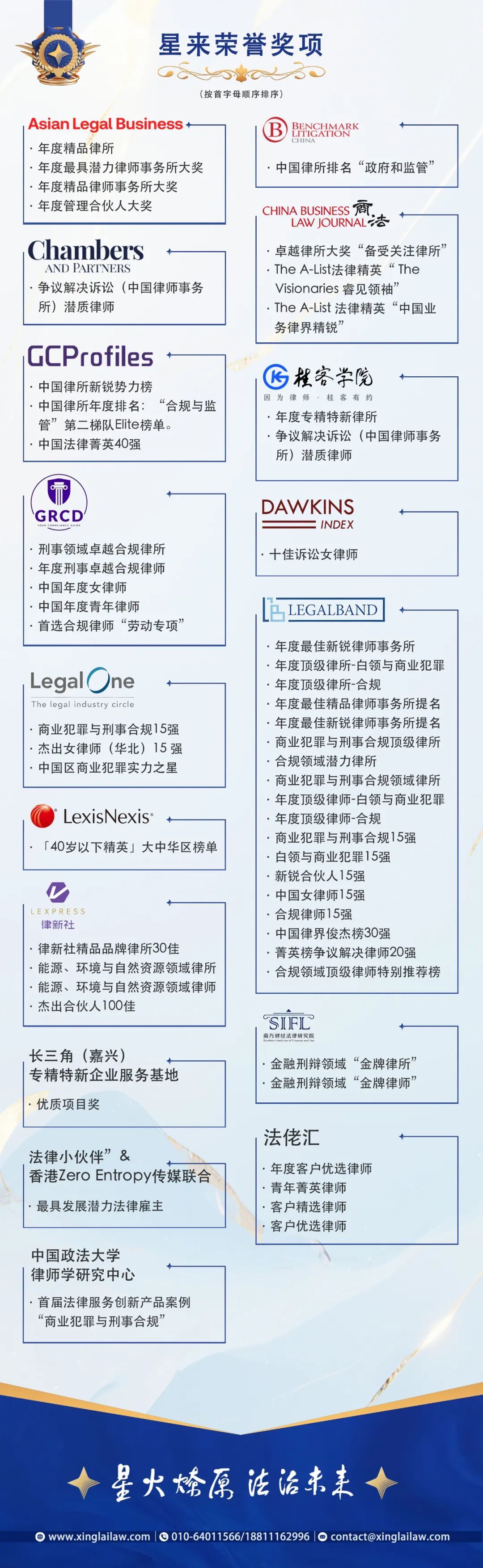
Member of the 10th Criminal Law Committee of the All China Lawyers Association; Deputy Director of the 12th Criminal Law Committee of the Beijing Lawyers Association; Independent Director at Peking University Pharmaceutical (000788); Recognized in the 2025 LEGALBAND China Top Lawyers Ranking for White-Collar & Business Crime and Compliance; Named among the Top 15 Lawyers on the 2025 LEGALBAND China Lawyer Special Recommendation List; Selected as a Special Recommendation Lawyer in the Compliance领域 in the 2024 LEGALBAND China Top Lawyers Ranking; Also recognized as one of the Top 15 Lawyers on the 2024 LEGALBAND China Lawyer Special Recommendation List for Business Crime and Criminal Compliance; Listed as an Elite Under 40 on the Greater China list by LexisNexis in 2024; Visiting Scholar at Cornell University and the University of Chicago; Vice Secretary-General of the Peking University Financial Alumni Association; Member of the Board of Directors of the Beijing Society of Criminology; and Member of the Board of Directors of the Beijing Association for Comparative Law, among other roles. He specializes in providing clients with comprehensive legal services that span criminal, administrative, and criminal-civil-intersectional areas, particularly in handling complex and challenging cases. His expertise extends to corporate crisis management, environmental protection, finance and securities, computer networks, intellectual property, and other specialized fields, where he has accumulated extensive practical experience.

.
Su Zhongming
Beijing Xinglai Law Firm
Member of the Management Committee, Head of the Compliance Center
Master of International Law from Jilin University. As one of the first batch of corporate compliance professionals certified at the senior level, I have handled numerous compliance cases and led the development of compliance management systems for central state-owned enterprises, public institutions, and private companies. Additionally, I successfully guided the team in completing the Compliance Demonstration Zone Project in Jiaxing City. I’ve also been frequently invited to share my expertise at Renmin University Law School’s prestigious "Corporate Compliance Case Study Seminar," as well as to deliver lectures and presentations for major central state-owned enterprises and other prominent organizations.

.
Xu Rui
Beijing Xinglai Law Firm
Partner
Master of Laws from Wuhan University. Named GRCD China's Young Lawyer of the Year 2025. Specializes in commercial dispute resolution, corporate legal services, and high-stakes criminal defense, as well as corporate compliance. Possesses extensive practical experience in areas such as commercial disputes, criminal defense, corporate litigation, and financial disputes. Has successfully represented clients in numerous cases where losses were recovered through retrial procedures and third-level review processes.

.
Li Zeyu
Beijing Xinglai Law Firm
Advisor
Master of Economic Law from Peking University. With over ten years of experience in legal and compliance management within the investment and financing sector, I specialize in private equity fund management, equity investments, antitrust compliance, and corporate governance. I have been involved in the full-cycle legal work of numerous private equity funds and M&A/restructuring projects, serving a diverse range of clients—including well-known private equity firms, various technology companies, and leading manufacturing enterprises.

.
Fan Yun
Beijing Xinglai Law Firm
Lawyer
Bachelor of Laws from China University of Political Science and Law, Master of Laws from Renmin University of China. Previously worked at a leading state-owned financial enterprise, gaining extensive practical experience in areas such as civil and commercial dispute resolution, corporate internal governance, criminal defense and prosecution, and managing significant legal risks. Leveraging expertise in the intersection of criminal, civil, and administrative law, I provide comprehensive, one-stop legal services tailored to clients—including numerous publicly listed companies and central enterprises.

.
Huang Xinran
Beijing Xinglai Law Firm
Lawyer
Master of Laws from Peking University. During my career, I have been involved in the criminal defense of numerous high-profile cases involving major economic and official misconduct crimes. Additionally, I have provided comprehensive and specialized compliance services to large state-owned enterprises, public institutions, and listed companies. I’ve also assisted multiple overseas construction subsidiaries of state-owned enterprises in navigating World Bank and multilateral development bank compliance investigations, as well as sanctions-related clearance processes. Furthermore, I’ve worked with Fortune Global 500 companies and publicly traded firms, offering support in responding to antitrust administrative penalties and implementing necessary compliance reforms.

.
Ma Xueyan
Beijing Xinglai Law Firm
Lawyer
Bachelor of Laws from China University of Political Science and Law, and Master of Laws from the University of Edinburgh in the UK. His primary practice areas include civil and commercial dispute resolution, criminal defense, ongoing legal advisory services, as well as corporate legal risk management and compliance. He serves clients across diverse sectors, including real estate, defense industry, retail, entertainment, manufacturing, and more.

.
Chen Yujie
Beijing Xinglai Law Firm
Lawyer
Doctor of Jurisprudence (J.D.) from the University of Sydney. Holds both Chinese legal practice qualifications and Australian New South Wales legal professional qualifications. Has represented clients in numerous criminal cases involving corporations and entrepreneurs, as well as cases of official misconduct. Additionally, has provided comprehensive and specialized compliance services to several large state-owned enterprises.
Beijing Headquarters Address: No. 8 Jianguomen North Avenue, Dongcheng District, Beijing 17th Floor, East Wing, China Resources Building
Wuhan Branch Office Address: Room 1001, 10th Floor, Huangpu International Center, Jiang'an District, Wuhan City, Hubei Province

Layout: Wang Xin
Review: Management Committee

Related News
2026-01-30
CONTACT US
Contact us
Beijing Headquarters
Address: 17th Floor, China Resources Building, No. 8 Jianguomen North Avenue, Dongcheng District, Beijing
Wuhan Branch Office
Address: Room 1001, Huangpu International Center, Zhaojiatiao, Jiang'an District, Wuhan City

Follow us

Digital Star Come
Case Consultation
Experienced lawyers offer free, no-obligation consultations to provide tailored solutions.
Copyright 2025 Beijing Xinglai Law Firm