

On July 5th, the academic seminar on "Enterprise Trade Secret Protection and Dispute Resolution under the Perspective of the Law on Promoting the Development of the Private Economy" was held in Beijing, jointly organized by the Training Department of the Chinese Behavioral Law Society and the Legal Think Tank for Promoting High-Quality Development of the Private Economy. The meeting took typical trade secret disputes in the new energy field as the entry point, conducting in-depth discussions around the legal boundaries in technology flow, innovative paths for industry governance, and difficulties in judicial practice.
Jiang Bixin, Deputy Director of the Constitution and Law Committee of the 13th National People's Congress, legal theory expert Xie Pengcheng Liu Guiming, Executive Director and Editor-in-Chief of the Editorial Board of the "Rule of Law Era" magazine published by China Democracy and Legal System Publishing House; Zhu Chongkun, Executive Deputy Secretary-General of the Chinese Behavioral Law Society; Wang Yanfang, Professor at the Intellectual Property School of East China University of Political Science and Law; Liu Chunyang, Second-level Inspector of the Hunan Provincial Committee of the Democratic League and Chief Advisor of the Legal Think Tank for Promoting High-Quality Development of the Private Economy; Xia Wei, Associate Professor at the School of Criminal Justice of China University of Political Science and Law; Hu Yongping, Partner of Hunan Yingqi Law Firm, Chairman of the Meeting and Director of the Legal Think Tank for Promoting High-Quality Development of the Private Economy; and more than ten other legal authorities, as well as over a hundred representatives from judicial organs, enterprises, and universities gathered together to explore ways to protect trade secrets.
In his speech, Zhu Chongkun pointed out that trade secrets, as the core competitiveness of enterprises in fierce market competition, are facing severe infringement challenges. Currently, trade secret infringement cases occur frequently, and legal practice faces issues such as vague definitions, difficulties in identifying infringement, and unreasonable calculation of damages. This seminar aims to gather wisdom from all parties to provide useful insights and experiences for enterprise trade secret protection and dispute resolution.
In his speech, Jiang Bixin emphasized that judicial organs, when handling trade secret infringement cases, must accurately understand and apply the Law on Promoting the Development of the Private Economy and related laws and regulations, strictly grasp the constitutive elements of trade secrets, standards for identifying infringement, and methods of assuming responsibility. Each case requires in-depth and detailed examination, comprehensively considering various factors to ensure the fairness and authority of the judgment results. It is necessary to avoid inconsistent judgments in similar cases caused by incorrect application of laws or inconsistent standards, which would damage the credibility of the law and the legitimate rights and interests of the parties involved.
Xie Pengcheng proposed from the perspective of enterprise self-governance and self-rescue that compliance management is a systematic tool for enterprises to protect trade secrets. He believes that trade secrets, as the key carrier of an enterprise's core competitiveness and innovative achievements, have protection effectiveness directly related to the survival and development of enterprises. Under the framework of the Law on Promoting the Development of the Private Economy, enterprises should not only protect their rights through legal means but also build a special compliance management system for trade secret protection. This includes compliance systems, mechanisms, cultural construction, and technical prevention measures to reduce the risk of trade secret leakage. At the same time, he calls on the state to help, guide, and encourage private enterprises to carry out compliance management, combining enterprise self-governance, self-rescue, and legal remedies to form a complete enterprise development guarantee system.
Liu Guiming discussed trade secret protection from the perspective of rule of law dissemination. He said that trade secret protection is closely related to everyone's interests. As a journalist, it is necessary to widely publicize it, thereby achieving the process from rule of law to dissemination, from dissemination to protection, and from protection to resolution.
Wang Yanfang shared from the practical perspective of handling trade secret disputes. She believes that the act of holding behavior constituting civil infringement of trade secrets should not be evaluated criminally based on the assessed value of the trade secret, but for subsequent disclosure and use, criminal evaluation should be conducted according to judicial interpretations of the criminal law.
Xia Wei said in his sharing that the essence of the market economy is competitive order, and the result of competition often benefits one party while harming the other. Trade secrets are a powerful competitive tool, protected in a non-public manner as a commercial element. However, due to factors such as non-disclosure, Chinese law has long paid insufficient attention to trade secret protection. With the promulgation and implementation of the Law on Promoting the Development of the Private Economy, how to clarify this issue properly in the dialogue between this law and the Criminal Law and protect trade secrets well is a theoretical topic worthy of attention.
Several experts at the meeting proposed suggestions on enterprise trade secret protection strategies: enterprises should establish and improve internal management systems, clarify the scope of trade secrets, standards for classification and confidentiality measures; fully utilize advanced technologies such as data encryption and blockchain to strengthen information security defenses; in external cooperation, clarify the confidentiality obligations and breach liabilities of partners through contract terms and strengthen performance supervision.
At the seminar, Wang Weining, founding partner of Beijing Xinglai Law Firm, combined typical trade secret dispute cases in the new energy field to deeply analyze legal boundary definitions, difficulties in judicial practice, and innovative paths for industry governance. The case involved a trade secret dispute of a high-tech enterprise in a certain area, where a former employee disclosed key technical information to a partner after leaving. The dispute focused on whether the partner's uninformed use of the technology constituted infringement, how to identify losses from unproduced projects, and whether the remedial actions of a good-faith partner affect liability determination. Around this case and common industry issues, the seminar formed three core discussion points: regarding legal boundaries, focusing on the nature of technology acquisition, new standards for infringement evidence, and evaluation of uncommercialized technology value; in judicial practice, exploring cross-handling of criminal and civil cases, allocation of burden of proof, and enterprise compliance exemption; in industry governance innovation, proposing the establishment of technical cooperation norms, improvement of compliance incentive mechanisms, and construction of diversified dispute resolution mechanisms.
The meeting finally reached a consensus: at the legislative level, it is recommended to improve trade secret identification standards and technical cooperation exemption scenarios in conjunction with the Law on Promoting the Development of the Private Economy and judicial interpretations; at the judicial level, advocate cautious use of criminal measures and prioritize resolving disputes through civil means; at the industry level, promote the establishment of a graded protection system for technical secrets and strengthen enterprise compliance construction.
Liu Chunyang pointed out that this seminar successfully built a cross-field, high-standard communication platform, gathering legal experts, enterprise representatives, and industry regulators, among others. Through the collision of ideas and sharing of experiences, it provided more diverse and innovative perspectives and ideas for the protection and dispute resolution of trade secrets in private enterprises.
In his concluding remarks, Hu Yongping said that reviewing the morning seminar, the guests outlined a blueprint from a macro perspective such as legislative improvement, laying a solid theoretical foundation for the growth of the private economy under the rule of law. The afternoon delved into practice, with guests from different fields sharing valuable experiences, bringing hope to enterprise development. The interactive discussion session was a collision of wisdom, with guests expressing their views on practical difficulties, making rule of law construction more grounded. After the seminar, three key consensuses were formed: enterprises' compliance awareness must keep pace with the new law; the vision for resolving trade secret disputes needs to be broadened; government, enterprises, academia, and media must work together.
Hu Yongping pointed out that "Law as the guideline, innovation as the wing, and cooperation as the strength" should become the banner and guide for subsequent work. Under the sunshine of the rule of law, the private economy will thrive, and trade secret protection will escort innovation vitality and core competitiveness.
This seminar was a complete success, not only providing theoretical support and practical experience for trade secret protection but also promoting exchanges and cooperation among all parties in trade secret protection, contributing to the high-quality development of the private economy.
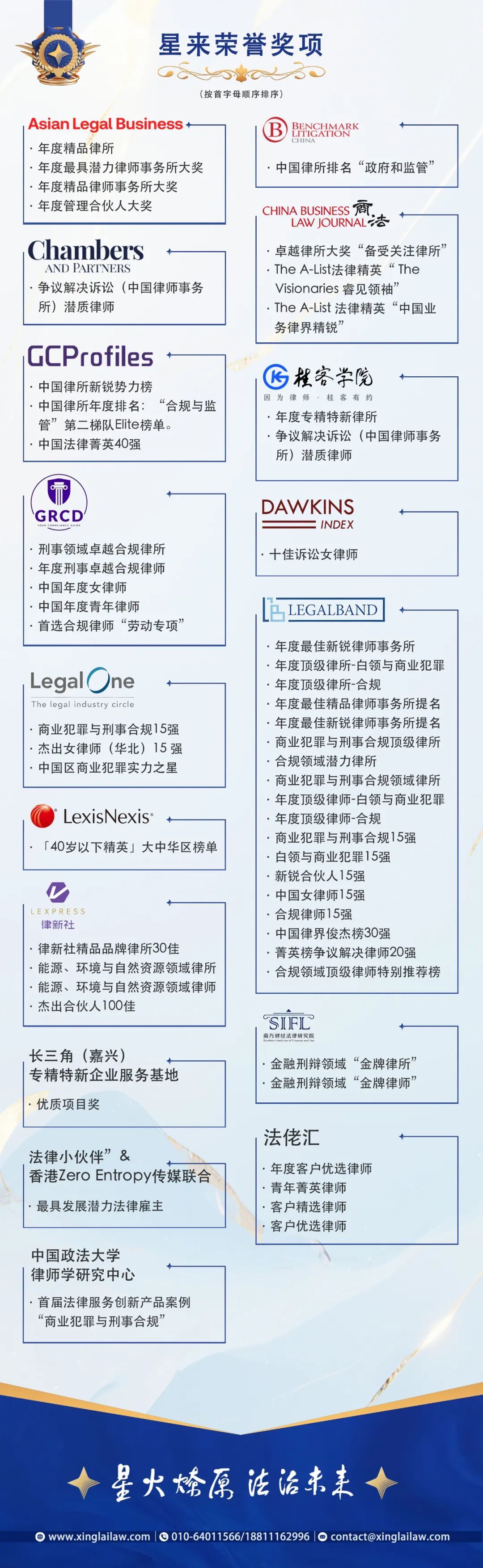
Beijing Headquarters Address: No. 8 Jianguomen North Street, Dongcheng District, Beijing 17th Floor, East Wing, China Resources Building
Wuhan Branch Office Address: Room 1001, 10th Floor, Huangpu International Center, Jiang'an District, Wuhan City, Hubei Province

Edited and Layouted by: Wang Xin
Review: Management Committee
Related News
2026-01-30
CONTACT US
Contact us
Beijing Headquarters
Address: 17th Floor, China Resources Building, No. 8 Jianguomen North Avenue, Dongcheng District, Beijing
Wuhan Branch Office
Address: Room 1001, Huangpu International Center, Zhaojiatiao, Jiang'an District, Wuhan City

Follow us

Digital Star Come
Case Consultation
Experienced lawyers offer free, no-obligation consultations to provide tailored solutions.
Copyright 2025 Beijing Xinglai Law Firm