

By circumventing regulations to discharge pollutants—such as tampering with or falsifying monitoring data, or directly releasing partial or entire volumes of wastewater or other contaminants into the environment without proper treatment facilities—ecological and environmental authorities may order corrective actions, impose production restrictions, or mandate temporary shutdowns for remediation. Violators will face fines ranging from RMB 100,000 to RMB 1 million. In severe cases, their pollution discharge permits may be revoked, and, with approval from the competent people's government, the facility could even be ordered to suspend operations or shut down entirely. Additionally, the case will be referred to public security authorities, where the directly responsible managers and other individuals bearing direct accountability may face detention for a period of 10 to 15 days. For less serious offenses, the penalty is a detention of 5 to 10 days. If a facility is ordered to make corrections but refuses to comply, it will be subject to continuous daily fines equivalent to the original penalty amount, as mandated by law.
Policy Evolution in Heavy Metal Pollution Prevention and Control
At the beginning of this century, incidents such as the cadmium pollution in Liuyang, the transformation of Guangdong’s Beijiang River into the "Red Water River," and the Taizhou "blood-lead crisis" brought heavy metal contamination to the forefront as one of the most closely watched public concerns. The CPC Central Committee and the State Council have paid close attention to this issue and have implemented a series of critical measures. In November 2009, the General Office of the State Council forwarded the "Guiding Opinions on Strengthening the Prevention and Control of Heavy Metal Pollution," jointly issued by the Ministry of Environmental Protection and other departments, outlining specific goals, key priorities, and relevant policy measures for tackling heavy metal pollution. In 2011, the Ministry of Environmental Protection, working together with the National Development and Reform Commission, the Ministry of Industry and Information Technology, the Ministry of Finance, the Ministry of Land and Resources, the Ministry of Agriculture, and the Ministry of Health, formulated and released the "12th Five-Year Plan for Comprehensive Prevention and Control of Heavy Metal Pollution." This plan prioritized specific pollutants, regions, industries, and enterprises for focused prevention efforts, clearly defining targets, tasks, and policy measures for heavy metal control. It also emphasized strengthening oversight of heavy metal pollution sources, gradually establishing a robust system for pollution prevention, an effective emergency response framework, and a comprehensive risk assessment mechanism linking environment and health—ultimately enabling more effective management and mitigation of heavy metal contamination.
In 2022, the Ministry of Ecology and Environment issued the "Opinions on Further Strengthening the Prevention and Control of Heavy Metal Pollution" (Document No. Huan Gutai [2022] 17, hereinafter referred to as the "Prevention and Control Opinions"), specifically aimed at enhancing nationwide efforts to control heavy metal pollution. The document underscores the need to further tighten emission regulations for heavy metal pollutants and effectively manage environmental risks associated with these contaminants. The Prevention and Control Opinions highlight that heavy metal pollution remains a significant issue in certain regions of China, posing serious threats to both ecological security and public health—a challenge that demands sustained and determined action. Looking ahead to the 14th Five-Year Plan period, the document emphasizes the importance of thoroughly implementing Xi Jinping’s Thought on Ecological Civilization, aligning with the overarching goal of synergistically reducing pollution and carbon emissions. With improving ecological and environmental quality as its core objective, the strategy focuses on effectively mitigating heavy metal-related environmental risks, driven by targeted reductions in key heavy metal pollutants. The opinions also stress the importance of maintaining a steady yet progressive approach, while prioritizing precision, science-based, and law-based pollution control measures. By focusing on high-priority heavy metal pollutants, critical industries, and specific geographic areas, the plan calls for comprehensive and integrated efforts to tackle heavy metal contamination head-on, ensuring robust protection of both ecological safety and public health.
Two
Environmental Compliance Risk Points for Heavy Metal Mining, Selection, and Processing Enterprises
The environmental compliance risks for heavy metal mining, beneficiation, and processing enterprises primarily manifest in the following areas:
(1) Administrative Penalty Risk
1. Discharging pollutants without an environmental discharge permit: Failure to obtain a pollution discharge permit before releasing wastewater, exhaust gases, or other pollutants—such as discharging with a forged, expired, or invalid permit—or continuing to pollute after the permit has been revoked, canceled, or withdrawn—will result in an order from the ecological and environmental administrative authority to rectify the situation, restrict production, suspend operations for remediation, or impose a fine of between 200,000 and 1 million yuan. In severe cases, the matter may be submitted to the people's government authorized to approve such actions for a decision to shut down operations or even close the facility entirely.
2. Excessive discharge of pollutants: Discharging pollutants exceeding emission standards, permitted concentration levels, or authorized emission limits may result in orders from the ecological and environmental administrative authorities to rectify the situation—or even impose restrictions on production, temporary shutdowns, or comprehensive remediation efforts—along with fines ranging from RMB 100,000 to RMB 1 million. In severe cases, the pollutant discharge permit may be revoked, and, with approval from the people's government authorized to do so, the facility could be ordered to suspend operations or shut down entirely. Additionally, if a facility is ordered to make corrections but refuses to comply, it will face continuous daily penalties equivalent to the original fine amount, as mandated by law.
3. Improperly operating pollution control facilities: By evading regulations to discharge pollutants—such as tampering with or falsifying monitoring data, or directly releasing partial or entire volumes of wastewater or other contaminants into the environment without proper treatment facilities—ecological and environmental authorities may order corrective actions, impose production restrictions, or mandate temporary shutdowns for remediation. Violators will face fines ranging from RMB 100,000 to RMB 1 million. In severe cases, their排污许可证 (pollution discharge permits) may be revoked, and, with approval from the competent people's government, the facility could even be ordered to suspend operations or shut down entirely. Additionally, the case will be referred to public security authorities, where the directly responsible managers and other individuals bearing direct accountability may face detention for a period of 10 to 15 days. For less serious offenses, the penalty is a detention of 5 to 10 days. If a facility is ordered to make corrections but refuses to comply, it will be subject to continuous daily fines equivalent to the original penalty amount, as mandated by law.
4. Failure to set up discharge outlets as required: If the location and number of pollutant discharge outlets, as well as the methods and destinations of pollutant discharge, do not comply with the provisions of the pollution discharge permit, the environmental protection administrative authority will order corrective action and impose a fine ranging from 20,000 yuan to 200,000 yuan. In cases of refusal to comply, the authority will mandate suspension of production for remediation.
5. Insufficient preventive measures against solid waste pollution: Unauthorized dumping, piling up, discarding, or scattering of industrial solid waste—and failure to implement appropriate preventive measures—resulting in the dispersal, loss, leakage, or other forms of environmental pollution from such waste will result in fines imposed by the ecological and environmental administrative authority, ranging from one to three times the actual disposal costs. If the required disposal costs are less than 100,000 yuan, the penalty will be calculated as 100,000 yuan.
(II) Criminal Penalty Risk
1. Illegal discharge, dumping, or disposal of hazardous waste: Illegally discharging, dumping, or disposing of more than three tons of hazardous waste constitutes a crime. For heavy-metal enterprises, if hazardous waste containing heavy metals generated during the production process is not handled according to regulations—such as being carelessly dumped, improperly stored, or illegally transferred—and the amount exceeds three tons, it could lead to criminal liability and face severe legal penalties under the Criminal Law.
2. Discharging pollutants containing heavy metals above regulatory limits: Discharging, dumping, or disposing of pollutants containing lead, mercury, cadmium, chromium, arsenic, thallium, or antimony at levels exceeding three times the national or local pollutant emission standards constitutes a crime. Similarly, discharging, dumping, or disposing of pollutants containing nickel, copper, zinc, silver, vanadium, manganese, or cobalt at levels surpassing ten times the national or local emission standards also qualifies as a criminal offense. Heavy-metal enterprises that fail to meet these standards—specifically by exceeding the permitted heavy-metal concentrations in wastewater, exhaust gases, or industrial waste—may face charges of environmental pollution crimes.
3. Evading regulations to discharge pollutants: Enterprises that evade regulation by discharging, dumping, or disposing of radioactive waste, waste containing infectious pathogens, or toxic substances through methods such as clandestine pipelines, seepage wells, seepage pits, cracks, sinkholes, injection practices, or by opening atmospheric emergency emission vents outside of emergency situations—these actions constitute criminal offenses. Additionally, heavy-metal enterprises engaging in production and operations while employing these regulatory-evasion tactics to release pollutants containing heavy metals will face criminal penalties.
(III) Other Risks
1. Damaged Environmental Reputation: Companies found to be violating environmental laws and regulations will have their infractions recorded, which can negatively impact their environmental credit rating. Businesses with poor environmental credit may face restrictions in areas such as government procurement, engineering bidding processes, and financial lending, potentially disrupting their normal operations and growth.
2. Public Opinion Pressure: The issue of heavy metal pollution often draws significant public attention. When companies engage in environmental violations, it can trigger widespread public condemnation and dissatisfaction, damaging their corporate image—and ultimately affecting their market competitiveness and customer relationships.
3. Civil Liability and Punitive Damages: According to the Civil Code and relevant environmental protection laws and regulations, in the event of heavy metal pollution incidents, enterprises are required to assume civil liabilities such as ceasing the infringement, removing obstructions, eliminating hazards, restoring the original state, compensating for losses, and issuing public apologies. They may also face substantial costs for ecological restoration and punitive damages related to their polluting activities. For instance, in the criminal public interest lawsuit filed by the Gulou District People’s Procuratorate of Nanjing City, Jiangsu Province, against Nanjing Suez Water Services Co., Ltd. for environmental pollution, the company was ordered to pay 237 million yuan toward ecological restoration costs. Additionally, its parent company, Suez Investment Co., Ltd., was held jointly and severally liable for this amount and committed to investing no less than 233 million yuan in alternative restoration projects.
Three
Key Points for Environmental Compliance in Heavy Metal Mining, Selection, and Processing Enterprises
(1) Streamline Environmental Compliance Procedures
1. Ensure that environmental impact assessment documents, pollution discharge permits, emergency response plans, and other related documents are complete and updated regularly.
2. New, renovated, and expanded projects must implement the "Three Simultaneous" system. Additionally, key industry construction projects undergoing new development, renovation, or expansion must comply with the "Three Lines and One List" framework, industrial policies, regional environmental impact assessments, strategic environmental assessments, and industry-specific environmental access control requirements. In priority areas, newly proposed, renovated, or expanded key industry projects must follow the principle of "reduction and substitution" for critical heavy metal pollutant emissions, with a substitution ratio no lower than 1.2:1. When submitting environmental impact assessment documents, project proponents must clearly specify the total amount and sources of key heavy metal pollutants to be emitted.
(II) Strengthen Pollution Control and Emission Management
1. Employ advanced technologies (such as membrane treatment and chemical precipitation) to treat heavy-metal-containing wastewater, and install an online monitoring system connected to regulatory authorities.
2. Regularly maintain waste gas treatment facilities (such as baghouse dust collectors and desulfurization equipment). Heavy non-ferrous metal smelting enterprises should enhance the collection and treatment of low-level fugitive emissions from production workshops, effectively minimizing uncontrolled emissions. For heavy non-ferrous metal mining and beneficiation enterprises that currently use simple dust control methods like water spraying or cyclone systems, it is essential to strengthen waste gas collection and undertake upgrades, such as installing filtration-based dust removal systems, to improve particulate matter control.
3. Heavy non-ferrous metal mining and beneficiation enterprises must, as required, improve rainwater and sewage separation systems around waste rock yards and spoil grounds, and establish facilities for collecting and treating acidic wastewater, ensuring that the treated effluent meets discharge standards before being released.
4. Standardize Solid Waste Management and Hazardous Waste Management
(1) Strengthen the prevention and control of tailings pollution: Tailings ponds shall be constructed in accordance with the "General Industrial Solid Waste Storage and Landfill Pollution Control Standard" (GB 18599-2020), and hazardous waste must be handled by qualified disposal units.
(2) Establish a solid waste ledger to enable full-process traceability.
(3) Strengthen environmental management at waste residue sites, and enhance measures such as leak prevention, loss prevention, and dust control. Promote the construction of harmless treatment systems for leaching residues and sulfur slag facilities, in line with relevant regulations, to support zinc hydrometallurgical processes.
(4) Implement strict environmental management throughout the collection, storage, transportation, and utilization/disposal processes of heavy-metal-containing solid wastes such as waste lead-acid batteries, smelting slag, and steel plant dust, to prevent secondary pollution.
(III) Regular Monitoring and Screening
1. Regular monitoring encompasses two key areas: environmental quality assessment and pollutant emission surveillance. The latter, tailored to the specific type of enterprise, involves tracking various forms of environmental pollution—such as water pollution, air pollution, noise pollution, and radioactive contamination. When building an environmentally compliant system, it’s crucial to emphasize robust monitoring mechanisms in these two areas, including but not limited to: monitoring of surrounding environmental conditions, methods of detection, frequency of testing, personnel involved, testing equipment, external inspection procedures, record-keeping practices, and protocols for reporting and addressing any anomalies. When evaluating the compliance of existing environmental monitoring systems, it’s equally important to pay close attention to the management of raw data. Data must be accurate and complete, backed by verifiable documentation that clearly traces its origin. Regardless of whether the data is stored electronically or in physical files, it should be securely managed by designated personnel. Furthermore, such data must be disclosed or submitted as required by applicable laws, industry standards, or actual environmental protection needs.
2. Conduct at least one environmental compliance audit or compliance risk assessment annually to identify and address potential issues.
(IV) Emergency Plans and Training
1. Improve environmental risk prevention and the identification and remediation of environmental safety hazards in accordance with laws and regulations, develop environmental emergency plans, stockpile relevant emergency supplies (such as heavy-metal leak-sealing materials), and conduct regular emergency drills.
2. Conduct environmental protection regulations and operational training for employees. Organizing specialized environmental training sessions will effectively disseminate knowledge related to environmental protection and production management, enhancing employees' environmental awareness and capabilities. This approach helps integrate theoretical knowledge with practical application, continuously refining daily work behaviors.
Four
Recommendations for Preventing Criminal Risks in Environmental Protection for Heavy Metal Mining, Selection, and Processing Enterprises
Previously, we outlined key points for compliance building in the environmental protection sector of heavy-metal mining and processing enterprises. In addition to ensuring compliance in companies' environmental initiatives, heavy-metal mining and processing firms should also pay close attention to effectively preventing criminal liability risks.
1. Fully identifying environmental compliance risks is the foundation and core component of conducting environmental compliance efforts. To accurately and comprehensively assess these risks, companies can engage external experts for detailed analysis and evaluation. It is recommended that key enterprises regularly engage professional environmental consultants or legal teams to review the compliance status of all their environmental management practices, thereby mitigating potential legal risks.
2. Key polluting enterprises are often also the primary focus of regulatory authorities, Communicating and reporting to government regulatory authorities is a key priority for heavily polluting enterprises aiming to ensure environmental compliance. During the process of building environmental compliance, enterprises should consider factors such as the frequency and methods of communication with government regulatory authorities, the proportion of effective communication, reporting and approval procedures, the manner and status of documenting communication exchanges, the timely submission of information and cooperation during investigations, and the implementation of mechanisms for reporting and handling sudden environmental incidents.
3. In the process of communicating with regulators, efforts should be made to communicate in writing and in a formal manner, and Properly retain relevant documentation, and ensure full and accurate compliance with the requirements of regulatory authorities.
Introduction to the Environmental Business Team Lawyer

.
Wang Weining
Beijing Xinglai Law Firm
Deputy Director, Founding Partner
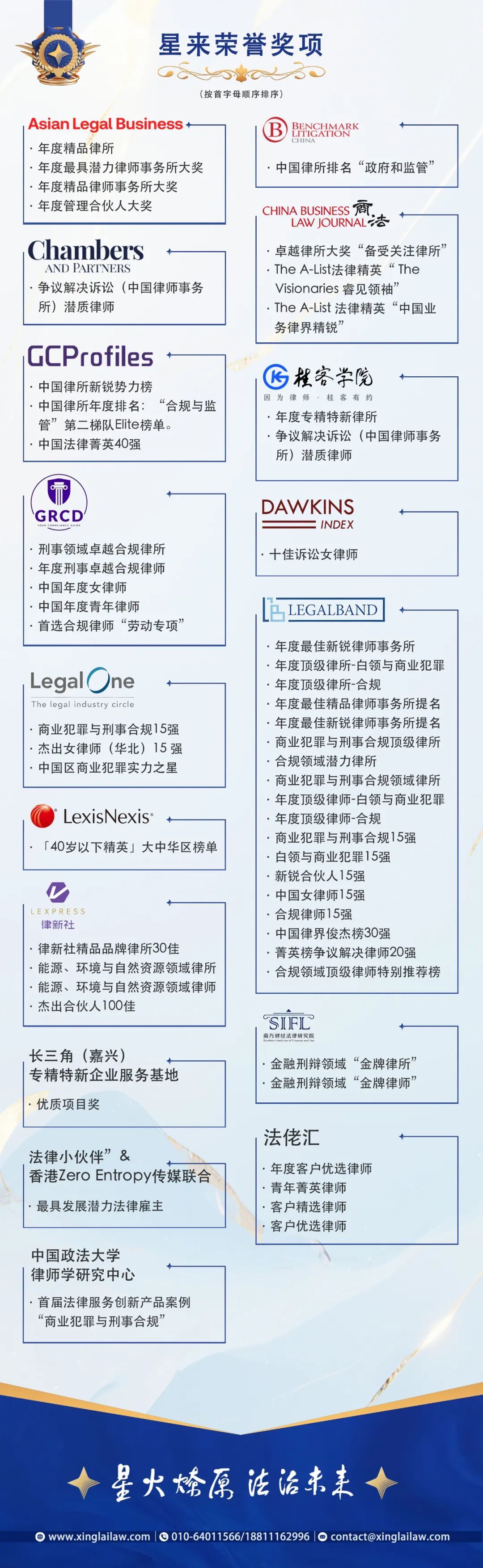
Member of the 10th Criminal Law Committee of the All China Lawyers Association; Deputy Director of the 12th Criminal Law Committee of the Beijing Lawyers Association; Independent Director at Peking University Pharmaceutical (000788); Recognized in the 2025 LEGALBAND China Top Lawyers Ranking for White-Collar & Business Crime and Compliance; Named among the Top 15 Lawyers on the 2025 LEGALBAND China Special Recommendation List; Selected as a Special Recommendation Lawyer in the Compliance领域 in the 2024 LEGALBAND China Top Lawyers Ranking; Also featured on the 2024 LEGALBAND China Special Recommendation List for Business Crime and Criminal Compliance; Listed as one of the "Under-40 Elite" in the Greater China region by LexisNexis in 2024; Visiting Scholar at Cornell University and the University of Chicago; Vice Secretary-General of the Peking University Financial Alumni Association; Member of the Board of Directors of the Beijing Society of Criminology; and Member of the Board of Directors of the Beijing Association for Comparative Law, among other roles. He specializes in providing clients with comprehensive legal services that span criminal, administrative, and civil-criminal-intersectional areas, particularly in handling complex and challenging cases. His expertise extends to corporate crisis management, environmental protection, finance and securities, computer networks, intellectual property, and other specialized fields, where he has accumulated extensive practical experience.

.
Su Zhongming
Beijing Xinglai Law Firm
Member of the Management Committee, Head of the Compliance Center
Master of International Law from Jilin University. As one of the first batch of corporate compliance professionals certified at the senior level, I have handled numerous compliance cases and led the development of compliance management systems for central state-owned enterprises, public institutions, and private companies. Additionally, I successfully guided the team in completing the Compliance Demonstration Zone Project in Jiaxing City. I’ve also been frequently invited to share my expertise at Renmin University of China’s School of Law—specifically, participating in the renowned "Corporate Compliance Case Study Seminar" hosted by distinguished faculty—and delivering lectures and presentations to major central state-owned enterprises and other prominent organizations.

.
Xu Rui
Beijing Xinglai Law Firm
Partner
Master of Laws from Wuhan University. Named GRCD China's Young Lawyer of the Year 2025. Specializes in commercial dispute resolution, corporate legal services, and high-stakes criminal defense, as well as corporate compliance. Possesses extensive practical experience in areas such as commercial disputes, criminal defense, corporate conflicts, and financial litigation. Has successfully represented clients in numerous cases where losses were recovered through retrial procedures and third-level review processes.

.
Li Zeyu
Beijing Xinglai Law Firm
Advisor
Master of Economic Law from Peking University. With over ten years of experience in legal and compliance management within the investment and financing sector, my expertise lies in private equity fund management, equity investments, antitrust law, and corporate governance compliance. I have been involved in the full lifecycle of legal work for numerous private equity funds and M&A/restructuring projects, serving a diverse clientele that includes well-known private equity firms, leading technology companies, and major manufacturing enterprises.

.
Fan Yun
Beijing Xinglai Law Firm
Lawyer
Bachelor of Laws from China University of Political Science and Law, Master of Laws from Renmin University of China. Previously worked at a leading state-owned financial enterprise, gaining extensive practical experience in areas such as civil and commercial dispute resolution, corporate internal governance, criminal defense and prosecution, and managing significant legal risks. Leveraging expertise in the intersection of criminal, civil, and administrative law, I provide comprehensive, one-stop legal services tailored to clients—including numerous publicly listed companies and central enterprises.

.
Huang Xinran
Beijing Xinglai Law Firm
Lawyer
Master of Laws from Peking University. During my career, I have handled numerous high-profile criminal defense cases involving major economic and official misconduct offenses. I’ve also provided comprehensive and specialized compliance services to large state-owned enterprises, public institutions, and listed companies. Additionally, I’ve assisted multiple overseas construction subsidiaries of state-owned enterprises with World Bank and multilateral development bank compliance investigations, as well as sanctions-related clearance processes. Furthermore, I’ve worked with Fortune Global 500 companies and publicly traded firms, offering support in responding to antitrust administrative penalties and implementing necessary compliance reforms.

.
Ma Xueyan
Beijing Xinglai Law Firm
Lawyer
Bachelor of Laws from China University of Political Science and Law, and Master of Laws from the University of Edinburgh in the UK. His primary practice areas include civil and commercial dispute resolution, criminal defense, ongoing legal advisory services, as well as corporate legal risk management and compliance. He serves clients across a diverse range of industries, including real estate, defense manufacturing, retail, entertainment, and manufacturing.

.
Chen Yujie
Beijing Xinglai Law Firm
Lawyer
Doctor of Jurisprudence (J.D.) from the University of Sydney. Holds both Chinese legal practice qualifications and Australian New South Wales legal professional qualifications. Has represented clients in numerous criminal cases involving corporations and entrepreneurs, as well as cases of official misconduct. Additionally, has provided comprehensive and specialized compliance services to several large state-owned enterprises.
Beijing Headquarters Address: No. 8 Jianguomen North Avenue, Dongcheng District, Beijing 17th Floor, East Wing, China Resources Building
Wuhan Branch Office Address: Room 1001, 10th Floor, Huangpu International Center, Jiang'an District, Wuhan City, Hubei Province

Layout: Wang Xin
Review: Management Committee
Related News
2026-01-30
CONTACT US
Contact us
Beijing Headquarters
Address: 17th Floor, China Resources Building, No. 8 Jianguomen North Avenue, Dongcheng District, Beijing
Wuhan Branch Office
Address: Room 1001, Huangpu International Center, Zhaojiatiao, Jiang'an District, Wuhan City

Follow us

Digital Star Come
Case Consultation
Experienced lawyers offer free, no-obligation consultations to provide tailored solutions.
Copyright 2025 Beijing Xinglai Law Firm