


Reference case: (2021) Gan1104刑初287
As one of the primary corporate offenses in the environmental protection sector, understanding and recognizing the crime of illegal mining is crucial for businesses aiming to operate compliantly, protect themselves effectively, and achieve sustainable development.
One
What is the crime of illegal mining?
According to Article 343, Paragraph 1, of the Criminal Law of the People's Republic of China, the crime of illegal mining refers to Individual or entity Violating the provisions of the Mineral Resources Law by mining without obtaining a mining permit, illegally entering state-planned mining areas, mining areas of critical national economic value, or others' mining territories, or unauthorizedly extracting specific mineral types subject to protective mining regulations as mandated by the state—when the circumstances are serious—shall be punishable by imprisonment of up to three years, criminal detention, or control, along with either a fine or a single penalty. In cases deemed particularly severe, the offender may face imprisonment for more than three but less than seven years, accompanied by a fine.
Two
Key Points of Acquittal in Judicial Practice of the Crime of Illegal Mining
Point of innocence No. 1: Stone materials are not classified as mineral resources under the law, and therefore do not fall within the scope of the crime of illegal mining. The object of the crime of illegal mining is mineral resources. However, during mining operations, not all extracted rocks qualify as mineral resources—those meeting the standards for mineral resources are referred to as "ore," while those that don’t meet these standards are called "waste rock." Therefore, in criminal cases involving illegal mining, Determining whether the extracted material qualifies as "ore" or "waste rock" is a critical criterion for distinguishing between criminal and non-criminal illegal mining activities—and serves as the basis for sentencing in such cases. In practice, it is essential to start with the conceptual meaning and scope of mineral resources, while considering relevant laws, regulations, policies for mineral resource management, as well as industry standards. Additionally, a precise determination of whether the object of mining operations in a specific case qualifies as "mineral resources" should be made, taking into account judicial appraisal opinions and input from administrative authorities.
Reference case: (2021) Gan1104刑初287
The court ruled: The stone materials used by the defendant for crushing do not qualify as naturally occurring mineral resources, and therefore do not fall under the scope of the crime of illegal mining. According to Article 2, Paragraph 1 of the "Detailed Rules for Implementation of the Mineral Resources Law of the People's Republic of China," "Mineral resources refer to natural resources—whether solid, liquid, or gaseous—that have practical value and are formed through geological processes." In this case, the stone materials processed by the defendant were remnants discarded from an old quarry prior to 2008; they were not naturally formed and thus lack the defining characteristics of natural resources, disqualifying them from being considered objects of the crime of illegal mining.
Second point of innocence: The entity did not obtain a mining license due to reasons beyond its control, and the mining activities were carried out with the tacit approval of the government and relevant authorities—thus, it would be inappropriate to classify this as illegal mining. The fact that a person has not obtained a mining permit does not automatically constitute a crime; instead, a comprehensive assessment must be made from the following perspectives: 1. Whether the individual failed to secure the mining permit due to their own reasons; 2. Whether the individual actually holds rights over the mineral resources within the designated mining area; 3. Whether the individual’s mining activities occurred outside of government oversight, severely undermining the mineral resource management system; 4. Whether there are other factors—beyond the individual’s control—that contributed to the unauthorized mining activity.
Reference Case: Case No. 1621 from Volume 141 of the "Criminal Trial Reference," involving Qinghai JM Industry (Group) Co., Ltd. and others accused of illegal mining
The court found that: The defendant, Qinghai JM Company, was invited by the Haixi Prefecture government to develop mineral resources. With the government’s support, the company secured resource allocation for the Erjing Field in the Jiangcang Mining Area and obtained both prospecting rights and approval for the mining area’s scope of operation. Subsequently, in line with the government’s policy of "one mining area, one development entity," JM Company transferred its prospecting rights to the newly integrated MLMY Group and successfully acquired an official mining license in July 2014. Meanwhile, although Qinghai JM proactively applied for the mining license, it faced delays due to government regulations mandating that licenses be processed uniformly by the integrated company—rather than by individual mining entities—and other factors such as corporate restructuring and shifting policy priorities. Despite these challenges, Qinghai JM never concealed its coal-mining activities. On the contrary, all aspects of the company’s operations—including integration efforts, production management, land-use approvals, explosives permits, and tax compliance—were conducted under the guidance and oversight of the government. There was no unauthorized or illegal mining taking place. Moreover, the government and relevant authorities had implicitly approved Qinghai JM’s corporate restructuring and coal-resource development through administrative contracts and meeting minutes. Although officials repeatedly emphasized the prohibition against unlicensed mining and warned against "using exploration as a substitute for extraction," they also imposed multiple administrative penalties. Yet, crucially, no concrete measures were ever taken to shut down the mine. Instead, the issuance of the mining license in July 2014 clearly demonstrated that Qinghai JM met all legal requirements for obtaining the permit—and that its mining activities were indeed carried out with the tacit approval of the government and related regulatory bodies. The administrative actions taken by the government and relevant departments led Qinghai JM Company to reasonably rely on them, forming the subjective belief at the time that its "exploration-for-mining" practice was lawful—and thus lacking any intent to engage in illegal mining. The defendant company, Qinghai JM Co., Ltd., and the defendants Zheng Moumou and others are found not guilty.
Point of innocence No. 3: Mining ore to protect property and eliminate safety hazards does not pose a social danger or constitute illegality, and therefore does not amount to the crime of illegal mining.
Reference case: (2022) Xiang 0521 Crim. Initial No. 749
The court held that in cases of illegal mining, it is essential to accurately determine the unlawful nature of the defendant’s mineral extraction activities. If the defendant mined resources as a defensive measure to protect property or eliminate safety hazards—essentially an act of self-defense—such actions should be recognized as legally permissible under criminal law, as they pose neither social harm nor illegality and thus do not constitute the crime of illegal mining. However, in cases where the same defendant engages in both defensive behavior and outright illegal mining activities, a clear distinction must be made, with each type of conduct judged separately according to the law.
Point Four of the defense: If the quantity of illegally mined mineral products or the value of mineral resources damaged does not meet the threshold for prosecution, it does not constitute a crime. In criminal cases involving illegal mining, it is essential not only to establish that the perpetrator engaged in the unauthorized extraction of mineral resources but also to accurately determine the quantity of minerals mined—and on this basis, assess the value of the illegally extracted products. When mounting a defense centered around the quantity of illegally mined materials, the following key points should be carefully considered: First, thoroughly scrutinize the reports produced by the expert appraisal agency. Pay close attention to the agency’s fieldwork, including exploration and measurement procedures, as well as its conclusions. Additionally, provide robust arguments addressing any technical concerns raised in the appraisal—such as the reliability of the reserve estimates, credibility factors, recovery rates, and recoverable reserves—to ensure that the amount of illegally mined resources is legally and reasonably determined. Second, leverage criminal evidence rules to mount an effective defense. Actively exercise your rights by requesting the investigative authorities to gather relevant evidence, and when faced with ambiguous or conflicting evidence, advocate for its interpretation in favor of the defendant, adhering to the principle that any doubt benefits the accused. Member of the 10th Criminal Law Committee of the All China Lawyers Association; Deputy Director of the 12th Criminal Law Committee of the Beijing Lawyers Association; Independent Director at Peking University Pharmaceutical (000788); Recognized in the 2025 LEGALBAND China Top Lawyers Ranking for White-Collar & Business Crime and Compliance; Named among the Top 15 Lawyers on the 2025 LEGALBAND China Special Recommendation List; Selected as a Special Recommendation Lawyer in the Compliance领域 in the 2024 LEGALBAND China Top Lawyers Ranking; Also featured on the 2024 LEGALBAND China Special Recommendation List as one of the Top 15 Lawyers in Business Crime and Criminal Compliance; Listed as an Elite Under 40 on the Greater China list by LexisNexis in 2024; Visiting Scholar at Cornell University and the University of Chicago; Vice Secretary-General of the Peking University Financial Alumni Association; Member of the Board of Directors of the Beijing Society of Criminology; and Member of the Board of Directors of the Beijing Association for Comparative Law, among other roles. He specializes in providing clients with comprehensive legal services that span criminal, administrative, and criminal-civil-intersectional areas, particularly in handling complex and challenging cases. His extensive experience includes expertise in corporate crisis management, environmental protection, finance and securities, computer networks, and intellectual property law. Additionally, during the defense process, it is advisable to hire authoritative experts in the fields of geology and mineral resources, as well as criminal law, depending on the specifics of the case. These experts can provide specialized analysis on technical issues related to determining the quantity of mineral products, issuing expert opinions and recommending that an expert assistant be called to testify in court. If necessary, parties may also consider commissioning or independently engaging professional institutions and specialists to assess the amount of illegally mined minerals based on materials provided by the client, ultimately producing a professional conclusion. This approach helps clarify the facts, effectively disqualify illegal evidence, and thereby challenge and refute the investigative authorities' expert assessments, ultimately enhancing the defense strategy.
Reference case: (2019) Shaanxi 01 Criminal Final Appeal No. 578
The court ruled: According to the "Interpretation on Several Issues Concerning the Application of Law in Handling Criminal Cases of Illegal and Destructive Mining," issued jointly by the Supreme People's Court and the Supreme People's Procuratorate, the threshold for the crime of illegal mining is defined as mining products valued at between 100,000 and 300,000 yuan—or causing damage to mineral resources valued at the same range. In this case, the defendant illegally mined sand and gravel worth 13,896 yuan, which falls below the statutory amount required to constitute the crime of illegal mining. Therefore, the defendant’s actions amount to a mere administrative offense rather than a criminal one.
Reference case: (2019) Liao 0381 Xing Chu 93
The prosecution's primary evidence alleging that the defendant company and the defendants Zhou Mei and Lian Mingsen committed the crime of illegal mining was the "Mineral Resource Damage Assessment Report" presented in court by the Liaoning Provincial Department of Land and Resources. This assessment, in turn, relied on the "Mine Over-Range Mining Resource Volume Detection Report" prepared by Institute A on October 21, 2014. However, the report’s calculation began with the defendant company’s 2013 annual mine reserve report submitted by Liaoning B Company, making it unable to accurately reflect either the exact amount of over-range mining conducted between October 27, 2013, and October 16, 2014, or the specific entity responsible for the unauthorized extraction. The expert opinion raises concerns regarding the extraction quantity: 1. The off-site data in the 2013 reserve report were inaccurate, leading to flaws in the sampling methodology used for this assessment. 2. The assessment conclusion was based on the "Mine Over-Extraction Resource Volume Detection Report" issued by Survey Institute A on October 21, 2014, which directly contradicts Company B’s 2014 Reserve Report, surveyed on September 23, 2014, and finalized on November 20, 2014. Notably, Company B’s 2014 Reserve Report explicitly stated that no over-extraction activities were detected during that year. 3. On September 6, 2013, the Haicheng City Bureau of Land and Resources imposed an administrative penalty on the defendant unit for over-extraction, determining that 4,867.62 cubic meters of granite had been mined beyond authorized boundaries. However, the appraisers confirmed in court that this specific amount of over-extraction within the V mining area was not deducted from the final report. 4. Neither the Liaoning Provincial Department of Land and Resources nor the Anshan City Price Certification Center appeared in court during this hearing. After the trial concluded, both entities submitted written statements indicating that the relevant appraisers were unable to attend due to unforeseen circumstances. According to legal guidelines, if an appraiser refuses to testify in court, their expert opinion cannot be used as the basis for reaching a verdict. The expert opinion identifies issues regarding the mining entity: The evidence provided by the prosecution identifying the period of illegal mining as the mine dynamic reserve report issued by Company B in October 2013. However, this report explicitly notes that historical mining pits were not vectorized or clearly marked. Therefore, the claim that the 220,000 cubic meters of illegally mined material were extracted between October 2013 and October 2014 lacks sufficient proof. Additionally, during the first court hearing of the original trial, expert witness Zhao stated that it was impossible to determine either the exact time or the identity of the person responsible for the mining activity. Furthermore, the only evidence linking the 220,000 cubic meters to Zhou Mei’s alleged theft comes from Liu Mou1’s whistleblower statement. Notably, the prosecution has failed to present concrete evidence regarding the specific individuals involved, the tools used, the vehicles employed, or the whereabouts of the stolen minerals. As for the criminal charges against Zhou Mei, Lian Mingsen, and Hongmou Construction Stone Mining Co., Ltd., the only evidence available is Zhou Mei’s own admissions—first made during the initial trial and again in the second hearing of the retrial—that "I didn’t mine at Pit No. 5, nor did anyone else." During the second retrial hearing, she even evaded further comment, stating, "I’d rather not say anything; I’ll wait until the court hands down my sentence before I speak." Based solely on this evidence, there is insufficient proof to establish that the defendants in this case engaged in unauthorized cross-border mining activities.
Point of innocence No. 5: Simply being employed to provide general labor for the crime of illegal mining, without prior collusion with those involved in the illegal mining activities, and without investing in the operation or receiving profit-sharing or high wages, does not constitute the crime of illegal mining.
Reference Case: (2018) Yu 0403 Xing Chu 176
The court found that the defendant, Li Moumou, was hired to provide labor services for the illegal mining operation. Based on testimonies from Yang Mou, Ren Mou1, and others, as well as Li Moumou’s own statements during investigation, prosecution, and trial, the existing evidence fails to establish that Li Moumou invested in or participated in the profit-sharing arrangement of the sand quarry, nor does it demonstrate any prior collusion between them. Li Moumou’s role involved issuing invoices for sand-hauling vehicles, a task assigned by Yang Mou to facilitate cost settlements between Yang Mou and the truck drivers. This activity is best characterized as routine labor, reflecting a clear employer-employee relationship. In 2017, the average annual wage in Henan Province’s mining industry was 56,661 yuan, while in Pingdingshan City, the average annual salary for employees working in non-private enterprises stood at 52,728 yuan. By contrast, Li Moumou’s monthly salary as an employee was only 3,000 yuan—far below the level typically associated with high, fixed wages in both the industry and the region. Moreover, Li Moumou’s multiple statements during police investigations, prosecutorial proceedings, and court hearings were consistent, coherent, and natural, further corroborated by the testimony of witnesses such as Yang Mou and Ren Mou1. In light of these findings, the court concludes that Li Moumou was merely employed to perform labor for the illegal mining operation, without engaging in profit-sharing arrangements or receiving a substantial, fixed wage. Additionally, there is no evidence indicating that Li Moumou had previously been penalized for illegal or destructive mining activities, nor did he engage in prior collusion with Yang Mou, the alleged perpetrator of the illegal mining scheme. Given the insufficient evidence to prove that Li Moumou acted with the criminal intent required under the crime of illegal mining, the court finds him not guilty.
Introduction to the Environmental Business Team Lawyers

.
Wang Weining
Beijing Xinglai Law Firm
Deputy Director, Founding Partner
Member of the 10th Criminal Law Committee of the All China Lawyers Association; Deputy Director of the 12th Criminal Law Committee of the Beijing Lawyers Association; Independent Director at Peking University Pharmaceutical (000788); Recognized in the 2025 LEGALBAND China Top Lawyers Ranking for White-Collar & Business Crime and Compliance; Named among the Top 15 Lawyers on the 2025 LEGALBAND China Special Recommendation List; Selected as a Special Recommendation Lawyer in the Compliance领域 in the 2024 LEGALBAND China Top Lawyers Ranking; Also featured on the 2024 LEGALBAND China Special Recommendation List as one of the Top 15 Lawyers in Business Crime and Criminal Compliance; Listed as an Elite Under 40 on the Greater China list by LexisNexis in 2024; Visiting Scholar at Cornell University and the University of Chicago; Vice Secretary-General of the Peking University Financial Alumni Association; Member of the Board of Directors of the Beijing Society of Criminology; and Member of the Board of Directors of the Beijing Association for Comparative Law, among other roles. He specializes in providing clients with comprehensive legal services that span criminal, administrative, and criminal-civil-intersectional areas, particularly in handling complex and challenging cases. His extensive experience includes expertise in corporate crisis management, environmental protection, finance and securities, computer networks, and intellectual property law.

.
Su Zhongming
Beijing Xinglai Law Firm
Member of the Management Committee, Head of the Compliance Center
Master of International Law from Jilin University. As one of the first batch of corporate compliance professionals certified at the senior level, I have handled numerous compliance cases and led the development of compliance management systems for central state-owned enterprises, public institutions, and private companies. Additionally, I successfully guided the team in completing the Compliance Demonstration Zone Project in Jiaxing City. I’ve also been frequently invited to share my expertise at the Renmin University of China School of Law’s prestigious “Corporate Compliance Case Study Seminar,” as well as delivering lectures and presentations to major central state-owned enterprises and other prominent organizations.

.
Xu Rui
Beijing Xinglai Law Firm
Partner
Master of Laws from Wuhan University. Named GRCD China's Young Lawyer of the Year 2025. Specializes in commercial dispute resolution, corporate legal services, and high-stakes criminal defense, as well as corporate compliance. Possesses extensive practical experience in areas such as commercial disputes, criminal defense, corporate litigation, and financial disputes. Has successfully represented clients in numerous cases where losses were recovered through retrial procedures and third-level review processes.

.
Li Zeyu
Beijing Xinglai Law Firm
Advisor
Master of Economic Law from Peking University. With over ten years of experience in legal and compliance management within the investment and financing sector, my expertise lies in private equity fund management, equity investments, antitrust law, and corporate governance compliance. I have been involved in the full-cycle legal work of numerous private equity funds and M&A restructuring projects, serving a diverse range of clients—including well-known private equity firms, various technology companies, and leading manufacturing enterprises.

.
Fan Yun
Beijing Xinglai Law Firm
Lawyer
Bachelor of Laws from China University of Political Science and Law, Master of Laws from Renmin University of China. Previously worked at a leading state-owned financial enterprise, gaining extensive practical experience in areas such as civil and commercial dispute resolution, corporate internal governance, criminal defense and prosecution, and managing significant legal risks. Leveraging expertise in the intersection of criminal, civil, and administrative law, I provide comprehensive, one-stop legal services tailored to clients—including numerous publicly listed companies and central enterprises.

.
Huang Xinran
Beijing Xinglai Law Firm
Lawyer
Master of Laws from Peking University. During my career, I have been involved in the criminal defense of numerous high-profile cases involving major economic and official misconduct crimes. I’ve also provided comprehensive and specialized compliance services to large state-owned enterprises, public institutions, and listed companies. Additionally, I’ve assisted multiple overseas construction subsidiaries of state-owned enterprises with World Bank and multilateral development bank compliance investigations, as well as sanctions-related clearance processes. Furthermore, I’ve worked with Fortune Global 500 companies and publicly traded firms, offering support in responding to antitrust administrative penalties and implementing compliance remediation measures.

.
Ma Xueyan
Beijing Xinglai Law Firm
Lawyer
Bachelor of Laws from China University of Political Science and Law, and Master of Laws from the University of Edinburgh in the UK. My primary practice areas include civil and commercial dispute resolution, criminal defense, ongoing legal advisory services, as well as corporate legal risk management and compliance. I serve clients across a diverse range of industries, including real estate, defense manufacturing, retail, entertainment, and manufacturing.

.
Chen Yujie
Beijing Xinglai Law Firm
Lawyer
Doctor of Jurisprudence (J.D.) from the University of Sydney. Holds both Chinese legal practice qualifications and Australian New South Wales legal professional qualifications. Has represented clients in numerous criminal cases involving corporations and entrepreneurs, as well as cases of official misconduct. Additionally, has provided comprehensive and specialized compliance services to several large state-owned enterprises.
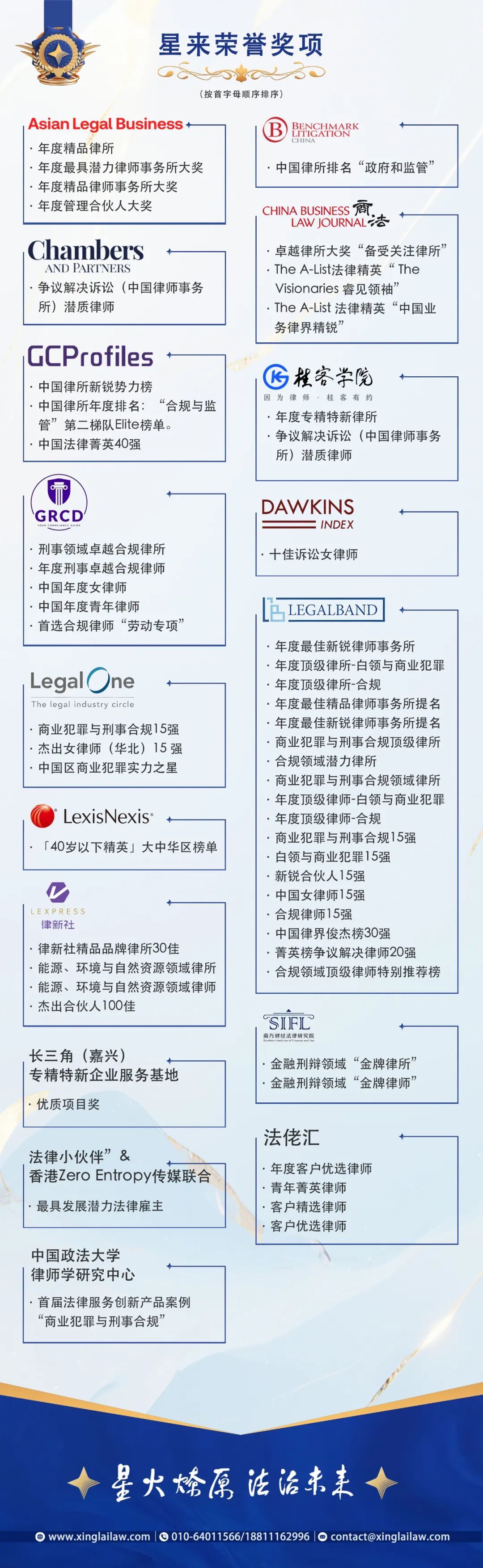
Beijing Headquarters Address: No. 8 Jianguomen North Avenue, Dongcheng District, Beijing 17th Floor, East Wing, China Resources Building
Wuhan Branch Office Address: Room 1001, 10th Floor, Huangpu International Center, Jiang'an District, Wuhan City, Hubei Province

Layout: Wang Xin
Review: Management Committee
Related News
2026-01-30
CONTACT US
Contact us
Beijing Headquarters
Address: 17th Floor, China Resources Building, No. 8 Jianguomen North Avenue, Dongcheng District, Beijing
Wuhan Branch Office
Address: Room 1001, Huangpu International Center, Zhaojiatiao, Jiang'an District, Wuhan City

Follow us

Digital Star Come
Case Consultation
Experienced lawyers offer free, no-obligation consultations to provide tailored solutions.
Copyright 2025 Beijing Xinglai Law Firm